
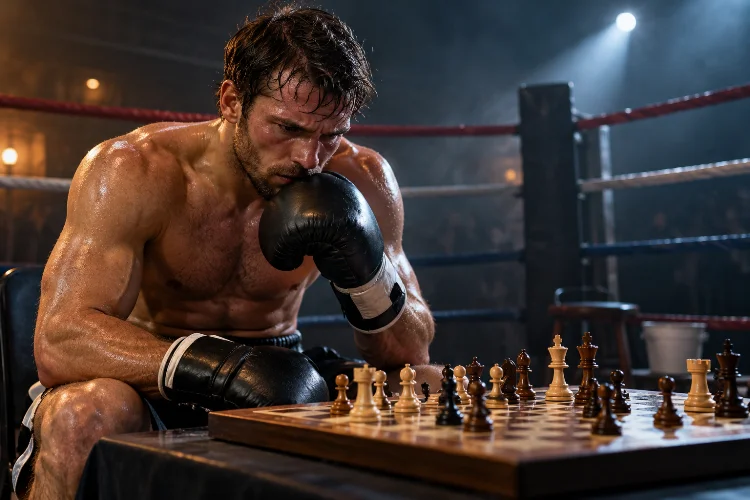
Imagine calculating a complicated chess position while your heart is still pounding from three minutes of boxing.
Your breathing is heavy, your shoulders are tired, and you have only seconds to decide whether moving a knight, exchanging queens, or launching an attack is the smartest choice.
A few minutes later, you are wearing boxing gloves again. That unusual switch is what makes chess boxing one of the most fascinating hybrid sports in the world.
Competitors alternate between rounds of chess and boxing, meaning a match can be won through checkmate, the chess clock, knockout, technical knockout, or other conditions defined by the event rules.
Modern chess boxing grew from an artistic concept into an organized sport during the early 2000s. Dutch performance artist Iepe Rubingh helped establish its alternating format after being inspired by Enki Bilal’s 1992 graphic novel Froid Équateur.
What makes the sport compelling is not simply combining two difficult activities. It forces athletes to think strategically while repeatedly recovering from physical stress.
Chess Boxing Is Built Around Constant Switching
The defining feature of chess boxing is the transition between two completely different competitive environments.
During the chess portion, competitors need concentration, pattern recognition, calculation, time management, and emotional control. During boxing, they suddenly need footwork, defensive awareness, punching combinations, reaction speed, strength, and cardiovascular fitness.
Then they must switch back.
Current competition formats vary between organizations and events. Some modern bouts use five or seven total rounds, while the historically familiar longer format can include up to 11 alternating rounds.
What remains consistent is the basic concept: chess and boxing repeatedly interrupt each other.
In several current formats, chess and boxing rounds last around three minutes, with roughly one minute between them to change equipment and prepare for the next discipline.
That transition period is crucial.
A competitor cannot spend several minutes calming down before returning to the chessboard. They have to lower their breathing, control adrenaline, remember the position, and continue calculating almost immediately.
Physical Fatigue Can Change Chess Decisions
Chess is normally played while sitting quietly.
Chess boxing deliberately removes that comfort.
After an intense boxing round, an athlete may return to the board with elevated heart rate, muscular fatigue, and strong emotional arousal.
Even ordinary competitive chess can create measurable physiological stress. Research on chess players has documented increased heart rate and sympathetic nervous-system activity during demanding games.
Add repeated boxing rounds and the challenge becomes even greater.
Research across sport suggests fatigue can interfere with cognitive processing when athletes approach exhaustion, particularly when rapid decisions and movement control are required.
A 2026 systematic review and meta-analysis also found mental fatigue was associated with poorer sport-related reaction time, technical execution, and decision-making performance, with decision-making showing a particularly consistent effect.
For a chess boxer, this could mean overlooking a tactical threat, choosing a safe move instead of the strongest one, or spending too much time calculating a position that would normally feel familiar.
One inaccurate decison can end the match.
Boxing Requires Mental Strategy Too
It would be a mistake to describe chess as the “mental” half and boxing as the purely physical half.
Boxing is highly tactical.
A boxer has to recognize patterns, predict attacks, control distance, manage energy, and decide whether to pressure an opponent or remain defensive.
Research involving boxers has found that mental fatigue can affect the ability to anticipate offensive and defensive actions, demonstrating that cognitive performance is important inside the ring as well as at the board.
This makes chess boxing especially interesting.
The athlete is not switching from thinking to not thinking. Instead, they are switching between two different kinds of thinking.
Chess rewards relatively deliberate calculation. Boxing demands fast perception and almost immediate action.
A competitor who spends too long thinking in the ring gets hit.
A competitor who moves too impulsively on the chessboard may get checkmated.
Successful chess boxers must therefore adjust the speed and style of their decision-making every few minutes.
The Chess Clock Creates Another Form of Pressure
Checkmate is not the only way the chess portion can decide a bout.
Running out of time can also mean defeat.
The same chess game normally continues from one chess round to the next. Pieces remain in their existing positions, and competitors resume using their remaining clock time after each boxing interruption.
That makes time management strategically important.
Imagine having a superior position but only 30 seconds remaining while your opponent still has several minutes. Playing perfect chess may no longer be realistic.
The athlete might instead simplify the position, exchange pieces, or choose moves that are easier to play quickly.
The situation becomes even more complicated because boxing can indirectly influence clock management.
A physically exhausted competitor may calculate more slowly. Someone who absorbed several hard punches may struggle to immediately reconstruct the chess position.
The chess clock keeps running regardless.
This means endurance protects more than punching ability – it can protect valuable thinking time.
Winning in One Discipline Changes Strategy in the Other
A chess boxer has to understand the entire match rather than treating each discipline independently.
Suppose one competitor is clearly stronger at chess but weaker in boxing.
They may want to create a sharp chess position where checkmate can arrive quickly. At the same time, their boxing strategy may become conservative: stay mobile, defend intelligently, and survive until the next chess round.
Their opponent faces the opposite problem.
A stronger boxer may want to apply heavy physical pressure before the chess specialist can convert an advantage on the board.
This creates unusual cross-disciplinary strategy.
A boxer who knows the chess position is becoming hopeless may increase aggression in the ring because a knockout becomes the best remaining path to victory.
Meanwhile, someone with a winning chess position may avoid unnecessary exchanges of punches.
The score is not divided neatly between two sports.
Each discipline influences how the other should be approached.
Emotional Control Is a Competitive Advantage
Boxing produces adrenaline.
Chess punishes impulsiveness.
That is a difficult combination.
Imagine taking a heavy punch moments before returning to the chessboard. Anger might encourage an athlete to immediately launch an aggressive attack with the queen, even though the position demands patience.
Strong chess boxers have to separate emotion from strategy.
They must also avoid carrying chess frustration into the boxing round. Blundering a rook can create panic, but charging recklessly into punches is unlikely to solve the problem.
This need for emotional control is one reason the one-minute transistion between disciplines matters so much.
Athletes need methods for quickly lowering arousal without becoming passive.
Controlled breathing can help restore composure, while rehearsed routines reduce the amount of mental energy required when switching equipment and returning to the board.
The ideal athlete is neither completely calm nor wildly aggressive.
They need the appropriate mental state for whatever comes next.
Physical Conditioning Protects Cognitive Performance
Training for chess boxing cannot simply mean playing chess and attending occasional boxing sessions.
Athletes need enough conditioning to recover quickly between physical rounds.
Aerobic fitness helps reduce the cost of repeated movement, while boxing-specific conditioning allows competitors to maintain footwork, punching technique, and defense as fatigue increases.
Muscular endurance matters too.
Shoulders that become exhausted after punching may still be tense when the athlete sits down to move chess pieces.
More importantly, good conditioning may leave more mental resources available.
When an athlete is near complete physical exhaustion, even basic tactical calculations can feel harder.
This creates an important training goal: the boxer should not simply survive three minutes of activity. They should finish the round capable of thinking again.
Training chess positions immediately after intense intervals can therefore imitate the unique demands of the sport more closely than practising both disciplines separately.
Strong Chess Skills Need to Work Under Time Pressure
Chess boxing rarely provides the relaxed environment of classical chess.
Competitors typically play some form of fast chess because only limited time is available between boxing rounds.
That means pattern recognition becomes extremely valuable.
An experienced chess player does not calculate every possible move from zero. Familiar tactical structures, opening ideas, mating patterns, and endgame concepts allow faster decisions.
This efficiency becomes even more important when fatigue increases.
A well-prepared competitor can rely partly on automatic recognition rather than attempting deep calculation while breathing heavily.
The same principle appears in boxing.
Experienced fighters recognize familiar movement patterns and attacks more efficiently than beginners.
Chess boxing therefore rewards deep practice in both disciplines because expertise reduces how much conscious processing is needed for routine situations.
When the brain is tired, efficiency matters.
The Transition May Be the Sport’s Hardest Skill
Individual chess ability and boxing fitness are obvious performance factors.
The transition between them may be the more unusual challenge.
A competitor can be excellent at chess when rested and excellent at boxing when focused entirely on fighting, yet struggle when forced to alternate between the two.
Modern chessboxing descriptions explicitly emphasize this switching problem: after a boxing round, athletes return to the exact chess position and must immediately resume decision-making under fatigue.
Training should therefore reproduce that disruption.
An athlete might play a short tactical chess sequence, perform a hard boxing interval, then return to the position without receiving additional analysis time.
This develops what could be called cognitive recovery speed.
The goal is to regain organized thinking while the body is still under stress.
That skill separates chess boxing from simply being good at two unrelated activities.
Chess Boxing Requires Two Different Types of Endurance
Physical endurace is the obvious requirement.
Athletes must repeatedly punch, defend, move, and absorb physical pressure without losing boxing technique.
But mental endurance matters just as much.
The chess position becomes more complex over time, clock pressure increases, and earlier boxing rounds may leave the competitor increasingly fatigued.
Meanwhile, each discipline creates information the athlete must remember.
Which punches has the opponent been using successfully? Is their right hand slowing down? What tactical threat was developing on the chessboard? How much clock time remains?
Managing all of that information creates cumulative cognitive load.
The best competitor is therefore not necessarily the strongest boxer or highest-rated chess player.
It may be the athlete whose combined performance deteriorates the least as the match progresses.
How Modern Chess Boxing Developed
The modern sport has an unusual cultural history.
French comic-book artist Enki Bilal imagined a chess-and-boxing competition in Froid Équateur in 1992. His fictional version did not yet use today’s rapid alternating format.
Dutch artist Iepe Rubingh later adapted the idea.
Rubingh’s crucial innovation was alternating chess and boxing rounds, creating the repeated mental-physical transition that now defines the sport.
He staged an early public performance in Berlin in September 2003 before organizing an official competition in Amsterdam later that year.
He subsequently founded the World Chess Boxing Organisation and helped expand the sport internationally.
What began partly as performance art developed into a genuine competiton requiring trained chess players, qualified boxers, referees, chess arbiters, clocks, medical supervision, and structured rules.
The original joke-like contrast between brains and brawn eventually revealed something serious: elite performance rarely depends exclusively on one or the other.
Chess boxing integrates mental strategy and physical endurance by forcing athletes to perform two demanding disciplines without fully recovering between them.
Competitors must calculate chess positions under clock pressure, box intelligently while fatigued, control their emotions, and repeatedly switch between deliberate reasoning and rapid physical reactions. A knockout can end the bout, but so can a checkmate or an empty chess clock.
That structure means neither chess ability nor boxing skill is enough by itself.
The strongest chess boxer is the athlete who can preserve both while stress accumulates.
If you’re curious about this hybrid sport, try solving a few difficult chess positions immediately after a hard workout. It offers a small taste of the central chess-boxing challenge: making smart decisions when your body would prefer to focus on simply catching its breath.
