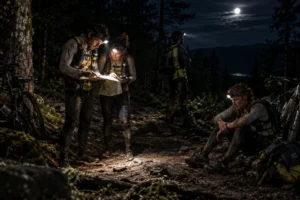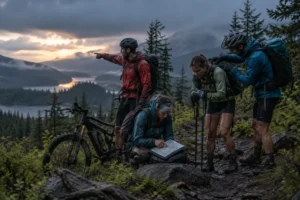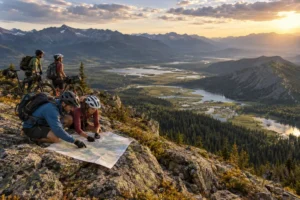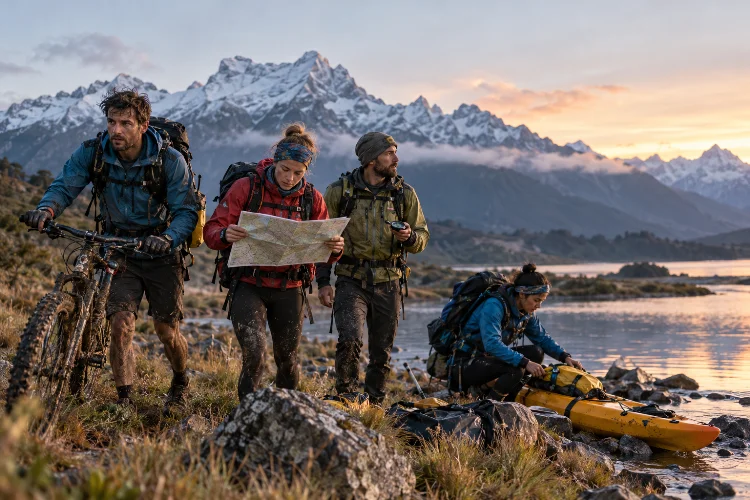
Imagine racing for hundreds of kilometres without a clearly marked route, switching between mountain biking, trekking, paddling, and technical terrain while trying to find checkpoints with nothing more than maps and a compass.
Now imagine doing it for several days with very little sleep.
That is the basic challenge behind multiday adventure races. Unlike marathons or triathlons, where competitors generally know exactly where they are going, adventure racing makes navigation part of the competition itself.
Teams must decide how to move through unfamiliar terrain while managing fatigue, food, equipment, weather, and each other.
The Adventure Racing World Series describes expedition races as events lasting roughly three to ten days, while major world championship courses can cover hundreds of kilometres.
This unusual combination means athletic speed alone is never enough. A powerful cyclist who chooses the wrong valley can lose hours, while a slower but smarter team may move ahead.
Multiday adventure racing tests whether athletes can keep thinking clearly long after their bodies want to stop.
Navigation Is at the Heart of Adventure Racing
The defining skill of adventure racing is navigation.
Teams normally receive maps showing checkpoints they must locate during the race. Instead of following arrows, painted lines, or a GPS route, racers use topographic maps and compasses to determine where they are and where they should go next.
USARA describes adventure racing as a primarily off-road, navigation-based multisport in which courses are not normally revealed until race time.
That creates an enormous strategic difference from traditional endurance racing.
Suppose two teams can run at the same speed. One chooses a direct route through thick vegetation and difficult elevation, while the other follows a slightly longer ridge that allows faster movement.
The shorter route may actually take much longer.
Navigation therefore involves more than pointing a compass toward the next checkpoint. Racers must read contour lines, understand terrain, recognize rivers and ridges, estimate distance, and constantly compare the map with what they see around them.
Why GPS Is Usually Restricted
Adventure racing deliberately protects this navigational challenge.
USARA states that GPS devices, smartphones, and other smart equipment generally cannot be used for navigation unless race organizers specifically permit them.
Trackers may still be carried for organizer safety and spectator tracking.
The distinction is important: organizers may know exactly where a team is, while the competitors themselves still have to work it out with traditional navigation tools.
Endurance Means More Than Covering Long Distances
A multiday race does not test endurance in the same way as a road marathon.
The challenge is not simply maintaining one running pace for several hours.
Athletes might trek through mountains, ride mountain bikes over rough tracks, carry equipment, paddle rivers or coastlines, and climb technical terrain.
At the 2026 Adventure Racing World Championship in Corsica, for example, organizers expect a course of around 500 kilometres incorporating trekking, mountain biking, packrafting, kayaking, rope work, and navigation.
Different disciplines fatigue the body in different ways.
Mountain biking can exhaust the legs. Paddling stresses the shoulders, back, and core. Trekking with equipment creates impact and muscular fatigue, while steep climbs can push heart rate dramatically higher.
The body must repeatedly switch between movement patterns.
That versatility is one reason adventure racers tend to train as all-round endurance athletes rather than specialists.
A great runner who cannot paddle efficiently can become a liability. An excellent cyclist who struggles on long trekking sections faces the same problem.
Sleep Deprivation Changes the Entire Competition
Perhaps the strangest feature of expedition racing is that the clock usually keeps running while athletes sleep.
There may be no scheduled overnight break.
Teams decide when – and sometimes whether – to stop.
USARA specifically identifies experience with sleep deprivation as one of the skills separating stronger adventure-racing teams from less experienced competitors.
This creates a difficult trade-off.
Skip sleep and you gain extra racing time, but judgement can deteriorate. Navigation errors become more likely, communication gets worse, reaction time slows, and athletes may begin moving less efficiently.
Sleep too long and better-rested competitors can disappear ahead.
Some expedition racers therefore use short strategic sleep periods rather than spending a normal night in a tent.
But pushing too far has consequences.
USARA’s adventure-racing terminology guide even references the famous “sleep monsters” – hallucination-like experiences exhausted racers can encounter during very long events.
When someone has been moving through darkness for days, the ability to tell a trail marker from an imaginary object becomes surprisingly valuable.
Route Choice Turns Endurance Into a Mental Puzzle
Adventure racing can be understood as an endurance sport mixed with a giant outdoor puzzle.
Finding a checkpoint is one problem. Deciding how to reach it is another.
A map might reveal several options: follow a winding road, climb directly over a ridge, travel along a river, or cut through forest.
Each option has costs.
A road may add distance but allow much faster movement. A direct line may appear efficient but involve dense vegetation, steep cliffs, marshland, or river crossings.
Experienced navigators learn to think in time rather than distance.
Five kilometres on smooth trail may be faster than two kilometres through steep bush.
The problem becomes even more complicated when fatigue builds. An aggressive shortcut that makes sense during hour three may be a terrible choice after two days of racing when the entire team is moving slowly.
Good teams constantly reconsider their strategy rather than blindly sticking to an original plan.
Transitions Can Win or Waste Huge Amounts of Time
Adventure races frequently switch disciplines at transition areas.
A team might arrive by mountain bike, pack away cycling equipment, change shoes, collect paddling gear, refill food, study the next map section, and then continue on foot or water.
Every minute spent standing still counts.
An individual transition that lasts five extra minutes may not seem important. But if the race includes numerous transitions, those delays can accumulate into a serious time loss.
Strong teams develop routines.
One athlete may prepare food while another studies the upcoming maps. Someone else manages equipment or checks mandatory gear.
Efficiency matters because multiday races already contain enough unavoidable delays.
The best teams try not to create new ones.
However, rushing can also backfire. Leaving a transition without required equipment, enough water, or a crucial map could cost far more time than spending another minute checking everything.
Teamwork Becomes an Endurance Skill of Its Own
Many major adventure races are team events rather than individual competitions.
That changes how endurance must be managed.
The goal is not for the strongest person to move at maximum speed. The goal is for the whole team to keep progressing.
If one member is struggling, teammates may carry extra equipment, reduce the pace, provide food, or even physically assist them on difficult sections.
Team chemistry becomes especially important under sleep deprivation.
After two or three days, minor disagreements can feel enormous. Decisions about route choice, rest, food, or pace can become emotionally difficult when everyone is exhausted.
USARA highlights team chemistry alongside navigation, strategy, and sleep management as a major factor in adventure-racing success.
Communication therefore needs to be practised just like cycling or paddling.
Successful teams learn when to question a navigation decision and when to trust the navigator. They also notice early signs that a teammate needs food, warmth, or a slower pace.
In a multiday race, supporting someone for twenty minutes can prevent a collapse that would cost hours.
Food and Hydration Become Strategic Decisions
Racing for multiple days requires a huge amount of energy.
But carrying unlimited food is impossible.
Teams have to decide what provides enough calories without creating excessive weight. Foods must also remain practical when athletes are tired, wet, cold, or moving continuously.
Appetite can become unpredictable during long endurance events.
A racer may know they need calories but feel unable to eat another sweet energy product after dozens of hours. Experienced athletes often bring a variety of textures and flavors to reduce food fatigue.
Hydration creates similar problems.
Teams must understand where water can safely be obtained and how much they need to carry between reliable sources.
Too little water risks dehydration. Too much adds unnecessary weight.
These decisions become part of overall race strategy, especially in remote areas where errors cannot easily be corrected at the next aid station.
Weather Can Completely Rewrite the Race
Adventure-racing courses are exposed to real environments rather than controlled stadiums.
Rain can transform a rideable dirt road into deep mud. Strong winds can make paddling much slower. Cold conditions may force athletes to use additional layers, while extreme heat increases hydration needs.
Fog can make navigation dramatically harder.
A visible mountain or ridgeline that would normally provide an obvious reference point may suddenly disappear.
This is why adaptability is so important.
USARA notes that adventure racers need to handle unexpected obstacles, imperfect maps, changing conditions, and course modifications.
The fastest theoretical route may stop being the best route after heavy rain.
Successful racers continually interpret what is actually happening rather than relying entirely on what they expected before the race began.
Checkpoints Reward Accuracy, Not Just Speed
Adventure races are organized around checkpoints or controls.
Some races require teams to visit every checkpoint in a specific order. Others use a rogaine-style format in which teams can choose between checkpoints or collect them in different sequences.
Expedition-length events commonly use point-to-point structures, although formats vary by organizer.
This system gives navigation real competitive consequences.
Running ten minutes faster means very little if a team spends forty minutes searching for a checkpoint because it entered the area from the wrong direction.
Good navigators therefore use attack points – recognizable terrain features close to the control – to reduce uncertainty.
A road intersection, stream junction, hilltop, or distinctive bend can provide a reliable final reference.
Navigation becomes especially delicate at night, when visual information is limited and even obvious daytime features may be difficult to identify.
This is where experienced teams often gain their biggest advantage.
Multiday Racing Rewards Consistency More Than Heroic Speed
New racers can be tempted to attack the opening hours aggressively.
That usually creates problems later.
An expedition event may last several days, meaning early speed is only useful if athletes can sustain something close to it.
Burning too much energy on the first bike leg can make later trekking painfully slow. Failing to eat early can create a calorie deficit that becomes almost impossible to fix.
Smart teams therefore think in terms of sustainable momentum.
They move quickly when terrain allows it, reduce effort when necessary, eat consistently, manage equipment carefully, and avoid unnecessary navigational risk.
This is very different from a short race where an athlete can afford to empty the tank near the finish.
Adventure racing punishes poor decisions slowly.
A mistake made on day one may not reveal its full cost until day three.
That is why experience matters so much.
Multiday adventure races test navigation and endurance by forcing athletes to solve physical and mental problems at the same time.
Teams may trek, mountain bike, paddle, climb, and navigate for hundreds of kilometres while dealing with sleep deprivation, changing weather, equipment management, food, route choices, and constant fatigue.
Finding checkpoints with maps and compasses means that moving fast is useful only when competitors are moving in the right direction.
The strongest teams are rarely just the fastest athletes. They are efficient navigators, disciplined endurance racers, adaptable problem-solvers, and reliable teammates.
That combination makes expedition racing one of the most complete outdoor challenges in endurance sport.
If you want to understand adventure racing better, start by studying a topographic map and trying an orienteering course. You may quickly discover that navigation can be every bit as demanding as the running itself.