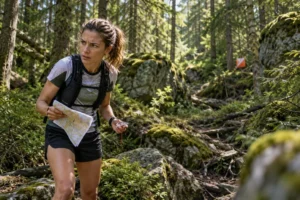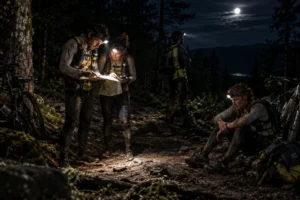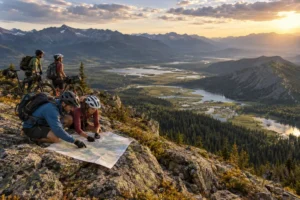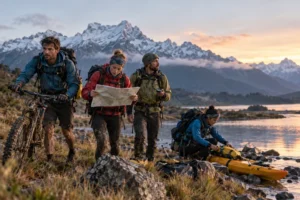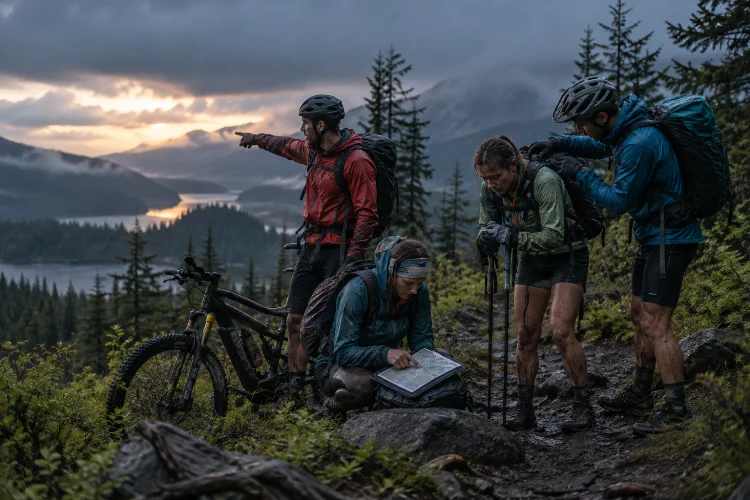
A team can contain four extremely fit athletes and still perform badly in a wilderness race.
Why? Because once competitors have been trekking, cycling, paddling, and navigating for dozens of hours, individual fitness becomes only part of the equation. Someone gets tired.
Another person makes a navigation mistake. Food runs low, temperatures drop, and a simple disagreement about which trail to follow suddenly feels much more important than it should.
This is where team dynamics in long-distance wilderness competitions become critical. In expedition adventure racing, competitors often travel together through remote terrain for multiple days.
Adventure Racing World Championship teams typically consist of four athletes who complete every section together, and current rules require members to stay close enough to see and communicate with each other.
Successful teams therefore need much more than endurance. They must communicate clearly, distribute responsibilities, control their pace, support struggling teammates, and keep making sensible decisions when everyone is tired.
In many cases, teamwork becomes an endurance skill of its own.
Wilderness Racing Turns Individual Problems Into Team Problems
In an individual ultramarathon, one athlete having a difficult hour mainly affects that athlete.
Team wilderness competitions work differently.
If one person slows down, the entire group usually slows down. Adventure Racing World Series rules require teams to travel and complete courses together rather than treating expedition racing like a relay where stronger athletes can simply move ahead.
That fundamentally changes race strategy.
The strongest cyclist cannot disappear up the road for twenty minutes. A fast runner cannot leave a struggling teammate behind during a trekking section.
Instead, the team has to manage differences in ability.
A powerful cyclist might carry additional shared equipment. Another racer may navigate while a teammate handles food or equipment. During difficult climbs, stronger members may take more weight to maintain the overall pace.
The target is not maximum individual performance.
It is maximum team performance.
Communication Becomes Harder as Fatigue Builds
Good communication sounds simple before a race starts.
After two days with little sleep, soaked clothing, sore feet, and limited food, it becomes considerably more difficult.
A normally harmless comment can sound aggressive. Someone may stop explaining their decisions clearly, while another teammate becomes too tired to ask questions.
USARA specifically identifies team chemistry, navigation, sleep deprivation, and strategy as factors that separate successful adventure-racing teams from less experienced groups. It also emphasizes that this understanding improves when athletes repeatedly race with an established team.
Strong teams develop simple communication habits.
Instead of saying, “I think we’re somewhere around here,” a navigator might explain that the team should encounter a stream within fifteen minutes and reassess if it does not appear.
Likewise, an athlete beginning to struggle should communicate early rather than remaining silent until exhaustion becomes severe.
Clear information gives the group time to respond.
Poor comunication turns small issues into large ones.
Navigation Works Better as a Shared Responsibility
Most teams have a primary navigator, but that does not mean everyone else should blindly follow.
USARA recommends establishing navigational roles before racing, including deciding who holds the maps, who makes final navigation decisions, and whether the team has a co-navigator capable of checking important choices.
This matters because even excellent navigators make mistakes.
The difference between a small error and a race-changing disaster is often how quickly someone notices that the surrounding terrain no longer matches the map.
A teammate who is not carrying the map can still monitor distance, notice a trail junction, remember a landmark, or question whether the group has been descending for longer than expected.
Avoiding Endless Trail Debates
Shared input does not mean every junction should become a committee meeting.
Teams can lose enormous amounts of time repeatedly debating navigation.
A practical system is to have one primary decision-maker while encouraging concise input from others. Once the decision is made, the team commits unless new evidence suggests the route is wrong.
That creates a useful balance between collaboration and speed.
Leadership Should Change With the Situation
The official team captain may represent the group administratively, but effective leadership during a wilderness race can shift constantly.
On a technical mountain-bike descent, the most experienced rider may naturally take responsibility for pace and safety.
During a difficult navigation section, the navigator leads.
If a teammate becomes cold, an athlete with strong wilderness experience may take over decisions about clothing, movement, or shelter.
This type of flexible leadership prevents one person from carrying every mental responsibility for several days.
Research into adventure racing has described team resilience as a dynamic process in which team members collectively interpret changing conditions and adapt their behavior as problems develop.
That is especially valuable in unpredictable environments.
A broken bike, sudden storm, lost piece of equipment, flooded river, or exhausted teammate may instantly make the original race plan irrelevant.
The strongest leader is not necessarily the loudest person.
Often, it is the person who recognizes when the plan needs to change.
Team Pace Should Be Based on the Weakest Current Link
Every member of a team will probably become the weakest athlete at some point.
It may happen because of climbing ability, cold tolerance, paddling technique, stomach problems, injury, or simple fatigue.
Experienced teams understand this and avoid treating weakness as failure.
Instead, they adjust.
Adventure Racing World Series reports frequently describe successful teams using sustainable pacing rather than attacking every section at maximum intensity.
One race-winning team, for example, credited maintaining a steady pace, good navigation, energy management, and positive team mood before increasing its effort later in the event.
That approach makes sense.
Driving one athlete beyond sustainable effort during hour ten may gain several minutes. If that person collapses during hour twenty, the team can lose several hours.
Long-distance competition rewards consistency.
Sometimes the fastest strategy is deliberately slowing down.
Strong Teammates Help Carry More Than Equipment
Adventure racing creates unusual opportunities for athletes to support each other physically.
If one competitor is fading, stronger teammates can take shared equipment, food, or other permitted loads. Teams may also use towing systems in disciplines where rules allow them, particularly during trekking or cycling.
Even small interventions can help.
A struggling racer may simply need someone to remind them to eat, adjust clothing, refill water, or slow the pace for ten minutes.
This requires awareness.
Teams perform better when athletes monitor one another instead of thinking only about themselves.
A teammate who stops speaking, begins stumbling, repeatedly misses instructions, or suddenly loses pace may be developing a serious fatigue problem.
Recognizing those signs early can protect both performance and safety.
The ability to recieve help matters too. Competitive athletes sometimes dislike admitting weakness, but refusing assistance can hurt the entire group.
Sleep Deprivation Tests Relationships as Much as Endurance
Multiday wilderness events can involve severe sleep restriction.
A 2024 study examining athletes in two international adventure races found average daily sleep during competition fell to roughly 2 hours 45 minutes to 2 hours 50 minutes, compared with more than seven and a half hours before the races.
The athletes accumulated substantial sleep debt and reported increased fatigue and impaired cognitive functioning.
This has obvious implications for teamwork.
Navigation requires concentration. Route planning requires judgement. Conflict management requires emotional control.
All of those become harder when athletes are severely tired.
Research outside adventure racing has similarly found that sleep loss can negatively affect team decision-making accuracy and problem solving.
Experienced racing teams therefore treat sleep strategically.
Sometimes continuing for another hour makes sense. At other times, a short sleep may improve the team’s movement speed and decision quality enough to compensate for time spent resting.
The difficult part is recognizing when everyone has become too exhausted to judge their own condition accurately.
Conflict Is Normal – Managing It Is the Real Skill
Put several tired people together in cold rain for three days and disagreements are almost inevitable.
The problem is not that conflict happens.
The problem is allowing disagreement to damage cooperation.
Common arguments can involve navigation, pace, when to sleep, how much food remains, equipment decisions, or whether to continue taking an aggressive route.
Strong teams separate the decision from the person.
Questioning a route choice should not become criticism of the navigator. Asking the team to slow down should not automatically be interpreted as weakness.
Teams that establish this mindset before competition can solve problems more quickly.
Humor can help as well.
Maintaining a positive atmosphere does not magically remove fatigue, but it can reduce emotional tension during difficult periods. Some successful adventure-racing teams explicitly describe protecting team mood as part of their strategy.
That psychological energy becomes surprisingly important after several days outdoors.
Roles Should Be Clear but Flexible
Long races become easier when everyone understands their responsibilities.
One person may lead navigation. Another may manage timing and distances. Someone else might organize shared equipment, while another regularly checks food or water.
Clear roles reduce unnecessary mental work.
But rigid specialization creates risk.
If only one athlete can navigate and that person becomes exhausted, the team has a serious problem.
USARA therefore recommends having additional teammates capable of supporting navigation and participating in important decisions.
The same principle applies elsewhere.
Everyone should understand essential gear. Multiple athletes should know how to repair basic bike problems. Team members should recognize common symptoms of dehydration, cold stress, or exhaustion.
Redundancy makes wilderness teams more resilient.
Trust Is Built Before the Starting Line
The worst time to discover that teammates have completely different racing philosophies is halfway through a six-day expedition.
One athlete may want to race aggressively with minimal sleep. Another may prefer conservative pacing and longer recovery stops.
Neither strategy is automatically wrong.
The problem appears when the team has never discussed it.
USARA recommends building racing experience with established teammates because chemistry and the ability to handle changing circumstances improve through shared experience.
Training together therefore has benefits beyond fitness.
Teams learn who becomes quiet when tired, who makes good decisions under pressure, who needs frequent food, who remains calm after navigaton mistakes, and who naturally raises morale.
Those details are almost impossible to discover through fitness tests alone.
Trust comes from knowing how teammates behave when conditions stop being comfortable.
Team dynamics can determine whether a long-distance wilderness competition becomes a successful expedition or a slow breakdown in communication.
Strong teams distribute responsibilities, share navigation information, pace themselves around collective ability, recognize fatigue early, and help weaker members without treating temporary struggles as failures.
Flexible leadership becomes essential when terrain, weather, sleep loss, and unexpected problems constantly change the situation.
Most importantly, successful wilderness teams understand that nobody remains the strongest member forever. Over several days, every athlete may need help – and every athlete may eventually provide it.
If you’re preparing for a team expedition race, don’t train only your endurance. Practise navigating, making decisions, solving problems, and getting tired together. Those shared experiences may become just as valuable as another long run or bike session.