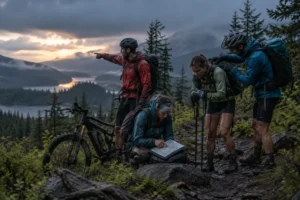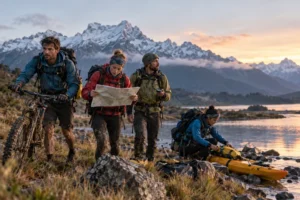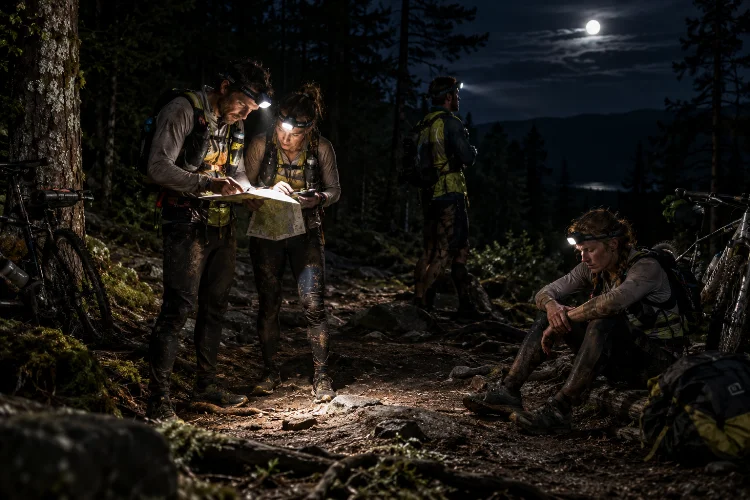
Finding the correct trail at 3 a.m. is difficult enough when you are well rested. Try doing it after two days of mountain biking, trekking, paddling, and navigating with only a few hours of sleep.
That is a normal problem in expedition adventure racing.
Multiday races often continue through the night, leaving teams to decide whether stopping for sleep is worth the time they lose while competitors keep moving.
The result can be extreme sleep restriction combined with physical exhaustion and constant pressure to make accurate decisions.
Research involving athletes in international adventure races found average sleep during competition fell to roughly 2 hours and 45–50 minutes per day, compared with more than seven and a half hours beforehand.
Athletes also reported increased fatigue and poorer cognitive functioning.
This makes sleep deprivation in adventure race decision making much more than a comfort issue. Lack of sleep can influence attention, navigation, risk perception, communication, and the ability to change a bad plan.
In a race where one wrong turn can cost hours, staying awake is not always the same as staying competitive.
Why Adventure Racers Become So Sleep Deprived
Most conventional endurance events eventually stop. Expedition adventure races can continue for several days with the race clock running almost constantly.
Sleeping therefore creates a strategic problem.
If a team sleeps for three hours, competitors who remain awake can potentially gain three hours. However, a rested team may later navigate more accurately and move faster.
USARA identifies sleep deprivation as one of the advanced challenges that separates expedition-style adventure racing from shorter events.
Once races stretch beyond roughly 12-24 hours, teams must manage nighttime navigation, fatigue, physical discomfort, and the mental challenge of continuing to think while tired.
Actual field research shows just how extreme this can become.
A 2024 study followed 24 racers across international events in Queensland and Alaska. Average daily sleep dropped from 7:46 to 2:50 in one race and from 7:39 to 2:45 in the other. The accumulated sleep debt remained measurable even a week after racing.
So the question is rarely whether athletes will become tired.
It is how well they can continue making decisions once they are.
Attention Lapses Can Turn Into Navigation Errors
Adventure racing depends heavily on sustained attention.
Navigators must compare terrain with maps, monitor distance, remember upcoming junctions, identify contour features, and notice when the landscape no longer matches expectations.
Sleep loss makes that harder.
Research on vigilant attention consistently shows that sleep deprivation increases response variability and makes sustained concentration more difficult. Importantly, these problems can accumulate across several days of restricted sleep.
Imagine a team expecting a trail junction 800 metres ahead.
A well-rested navigator may notice the faint turn immediately. A sleep-deprived navigator could walk past it while concentrating on something else, then continue for another kilometre before realizing the mistake.
The original error may take two seconds.
Recovering from it may take forty minutes.
That is why tiny concentration failures can become expensive in expedition racing.
Sleep Loss Can Make Risk Assessment Less Reliable
Route selection often involves uncertainty.
Should a team follow a safe road that adds five kilometres or take a shorter route through complicated forest? Should they cross a river now or travel farther to a bridge? Should they continue through the night or stop for sleep?
These decisions require balancing possible gains against potential losses.
Research suggests sleep deprivation can interfere with that balance, although individual responses vary.
One controlled study found that several nights of partial sleep restriction increased risky choices and reduced the amount of information some participants gathered before making decisions. People who were normally cautious could become more risk-prone when sleep restricted.
Another experiment following approximately 49 hours without sleep found participants increasingly selected disadvantageous high-risk options during a decision-making task.
However, the science is not as simple as saying tired people always take more risks. Recent reviews show the effect varies according to the task, individual, duration of sleep loss, and whether decisions involve gains or losses.
For adventure racers, the practical lesson is straightforward: being confident about a risky shortcut at 4 a.m. does not necessarily mean it is a good idea.
Cognitive Flexibility Becomes Harder When Plans Change
Adventure racing rarely unfolds exactly as expected.
A mapped trail may have disappeared. Heavy rain may make a river unsafe. A bike could break. A teammate may suddenly become exhausted.
Successful teams have to abandon plans and create new ones quickly.
This ability is called cognitive flexibility, and sleep deprivation can interfere with it.
A recent review of research on sleep loss and cognitive flexibility found studies reporting increased task-switching errors, slower responses, reduced inhibition, and difficulty reallocating attention after prolonged wakefulness.
This matters because tired athletes can become mentally attached to an original plan.
For example, a team may have decided before the race that a direct mountain route is fastest. When they arrive, the ground is wetter and slower than expected.
A rested team might immediately reconsider.
A severely fatigued team may keep following the original decison simply because changing it requires more mental effort.
In adventure racing, stubbornness can sometimes look like determination until several hours disappear.
Sleep Deprivation Can Damage Team Communication
Decision making in adventure racing is rarely individual.
One racer may navigate, another tracks distance, and other teammates provide information about terrain, pacing, equipment, or physical condition.
That system depends on communication.
Older research on sleep deprivation has found particular difficulty with tasks requiring unexpected problem solving, plan revision, competing information, and effective communication.
These are almost perfect descriptions of expedition racing.
Exhausted teammates may explain themselves poorly or become impatient with questions. A navigator might interpret someone checking the route as criticism rather than useful verification.
Minor disagreements can then grow.
Teams can reduce this problem by establishing decision rules before extreme fatigue appears. For example, one person may serve as primary navigator while another regularly verifies major turns.
When everyone already understands their role, less mental energy is needed to decide who should make each call.
The Famous “Sleepmonsters” Can Distort Reality
Adventure racers even have their own word for one of the strangest effects of prolonged wakefulness: sleepmonsters.
USARA describes sleepmonsters as hallucination-like experiences that commonly appear several nights into expedition races when athletes have accumulated severe sleep deprivation.
A tree stump might appear to be a person.
A rock could resemble an animal. Objects at the edge of a headlamp beam may appear to move.
These experiences can sound amusing afterward, but in the middle of remote terrain they demonstrate how unreliable perception can become.
An athlete who is hallucinating may also be struggling with concetration, navigation, balance, and judgement.
At that stage, continuing without rest may no longer provide the strategic advantage the team thinks it does.
Simply remaining awake does not guarantee productive racing.
Strategic Napping Can Sometimes Save More Time Than It Costs
Stopping to sleep feels psychologically difficult during a nonstop race because the clock keeps moving.
Yet the real calculation should not be “How much time will we lose by sleeping?”
It should be “How much faster and smarter will we become afterward?”
A recent systematic review covering sleep and ultra-endurance performance found evidence that pre-race sleep quality and mid-race naps may support cognitive performance, although researchers emphasized that sleep-performance relationships are complex and vary considerably between athletes and events.
This makes strategic napping potentially valuable.
Suppose a team takes a 30-minute nap and then avoids a two-hour navigation mistake. The sleep stop effectively saves time.
The challenge is deciding when rest becomes necessary.
Experienced teams often monitor more than physical tiredness. Repeated navigaton errors, unusual irritability, inability to perform basic calculations, stumbling, or teammates repeatedly forgetting instructions may all signal declining mental performance.
Waiting until everybody is completely dysfunctional can make recovery much harder.
Sleep Strategy Should Begin Before the Race
Managing sleep does not begin when athletes first become exhausted.
Preparation before an expedition can matter too.
The recent systematic review of ultra-endurance athletes found that extended sleep before competition may offer performance benefits in some situations.
Teams can also discuss their sleep strategy beforehand.
They might identify sections where short rests are likely to be efficient, decide what symptoms will trigger a sleep discussion, and agree that any teammate can raise concerns about cognitive deterioration.
Athletes should also understand that responses to sleep loss differ substantially between individuals.
Research on vigilant attention shows large person-to-person differences in vulnerability. Some people maintain performance relatively well for longer, while others experience substantial lapses much earlier.
Learning those patterns requires experience.
A team that has trained and raced together may already know that one member becomes quiet when tired while another becomes excessively confident.
Recognizing those behavioral changes can be just as valuable as reading a watch.
Decision Checklists Can Protect Tired Teams
When cognitive ability declines, simplifying decisions becomes useful.
Instead of debating every route from scratch, teams can use a short mental checklist: Is the route legal? What is the terrain like? How much climbing is involved? What happens if navigation fails? Are we physically capable of executing it right now?
The goal is not to remove judgement.
It is to prevent important factors from disappearing when attention is poor.
Teams can use a similar process before dangerous river crossings, difficult nighttime descents, or decisions to skip sleep.
This is particularly valuable because fatigue may also affect self-monitoring.
Adventure racers in the 2024 field study reported substantial cognitive impairment during their events, yet perceived recovery after the race occurred faster than their accumulated sleep debt actually disappeared.
In other words, how alert someone feels may not perfectly represent their underlying sleep deficit.
Structured decision habits provide another layer of protection when subjective confidence becomes unreliable.
The Fastest Team Is Often the Team That Can Still Think
Adventure racing rewards physical endurance, but expedition events repeatedly prove that endurance without judgement has limited value.
A team may gain twenty minutes by skipping sleep and then lose ninety minutes after missing a checkpoint.
Another team may ride faster but choose the wrong valley.
The strongest expedition teams therefore manage cognitive resources alongside food, water, equipment, and physical energy.
Sleep becomes part of race strategy rather than simply a biological inconvenience.
This does not mean teams should automatically sleep for long periods every night. In a competitive event, excessive rest can obviously cost positions.
The skill is recognizing the point at which additional wakefulness produces diminishing returns.
That threshold is different for every team and every race.
Learning where it lies can be one of the most difficult – and valuable – skills in expedition competition.
Sleep deprivation influences adventure race decision making because racing for several days requires exactly the cognitive abilities that prolonged wakefulness can weaken: attention, flexible thinking, navigation, risk assessment, communication, and self-monitoring.
Field research shows that adventure racers may average less than three hours of sleep per day during competition, producing enormous cumulative sleep debt.
The result is not simply feeling tired. Small concentration failures can become missed checkpoints, poor risk calculations can lead to bad routes, and extreme exhaustion can produce hallucination-like sleepmonsters.
The smartest teams therefore treat sleep as another strategic resource.
If you’re preparing for an expedition race, practise more than staying awake. Learn how your judgement changes when tired, establish team decision procedures, and recognize when a short sleep could ultimately make you faster rather than slower.