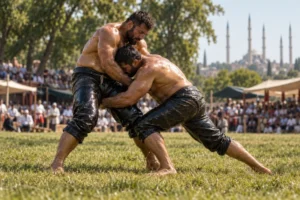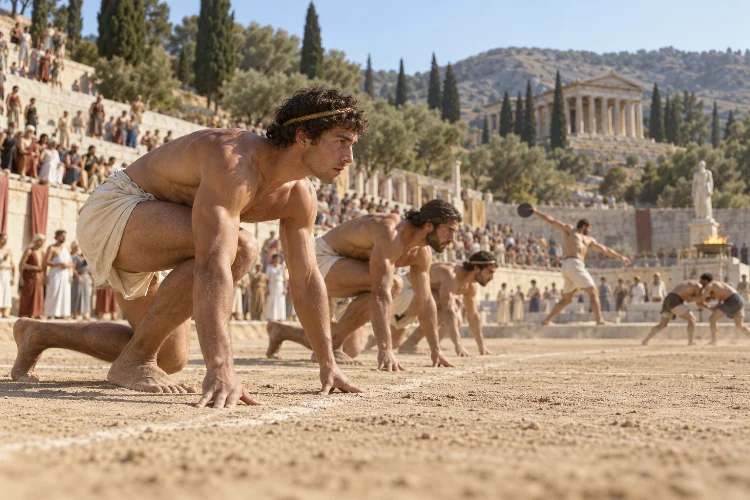
Thousands of years before packed stadiums, global championships, and televised sporting finals, crowds were already gathering to watch athletes race, wrestle, box, throw the discus, and drive chariots.
For the ancient Greeks, however, sport was about far more than entertainment.
Athletic festivals were deeply connected with religion, civic identity, personal honor, and competition between communities.
The Olympic Games at Olympia became the most famous example, but they formed only one part of a much larger network that included the Pythian, Nemean, Isthmian, and Panathenaic festivals.
The traditional date for the first recorded Olympic Games is 776 BCE, when Koroibos of Elis was named winner of the stadion footrace. By the sixth century BCE, major contests across the Greek world were forming a recognizable circuit for ambitious athletes.
Ancient Greek athletic festivals helped establish ideas that remain familiar today: scheduled championships, trained competitors, officials, standardized events, prestigious prizes, and public celebration of sporting excellence.
Athletic Competition Was Originally Part of Religious Festivals
Ancient Greek sport cannot really be separated from religion.
The Olympic Games were celebrated at Olympia in honor of Zeus. The Pythian Games at Delphi honored Apollo, the Nemean Games were associated with Zeus, and the Isthmian Games near Corinth honored Poseidon. These were sacred gatherings as well as athletic contests.
Competitors did not simply arrive, race, collect a prize, and leave. Religious sacrifices, prayers, processions, and ceremonies surrounded the sporting program.
That made athletic success culturally significant.
Victory could suggest excellence not only in physical ability but also in a setting connected with divine favor, civic pride, and public honor. A champion’s achievement therefore carried meaning beyond the stadium itself.
This combination of ceremony and competition helped create an important sporting traditon: major athletic events became occasions worth traveling for, preparing for, and celebrating collectively.
Modern opening ceremonies and symbolic sporting rituals are very different in religious meaning, but the ancient festivals demonstrate just how old the idea of wrapping competition inside a larger cultural spectacle really is.
The Panhellenic Circuit Created an Early Championship System
One of the most influential developments was the emergence of the four major Panhellenic festivals.
The Olympic Games were held every four years. By the sixth century BCE, major competitions were also established at Delphi, Nemea, and Isthmia. Together, they formed what Greeks could recognize as a circuit of prestigious contests.
This changed the nature of athletic competition.
An exceptional wrestler or runner did not have only one local festival to target. Talented athletes could travel through the Greek world and attempt to win at several celebrated venues.
The schedule also encouraged athletes to plan their careers around recurring competitions.
Nemean contests, for example, were held every two years for much of their history, while the Pythian Games developed into a major four-year festival.
In practical terms, this looked surprisingly familiar.
Modern athletes follow circuits involving national championships, continental tournaments, world championships, and the Olympics.
Ancient Greece obviously lacked today’s international federations, rankings, and media systems, but recurring high-status events created an early culture of traveling competitors chasing sucess across multiple venues.
Standard Events Made Athletes Comparable
Organized competition becomes much more meaningful when participants compete under recognizable formats.
Ancient Greek festivals gradually developed well-established athletic disciplines. These included running races, wrestling, boxing, discus throwing, javelin throwing, long jumping, horse racing, chariot racing, and the pentathlon.
There was also pankration, an extremely demanding combat event combining elements of wrestling, boxing, and kicking. Biting and eye-gouging were among the few actions specifically prohibited.
The pentathlon is particularly interesting because it combined several different skills rather than rewarding a specialist in only one movement.
Greek athletics, however, focused heavily on beating opponents rather than setting numerical records. The Metropolitan Museum of Art notes that ancient Greek sport generally emphasized individual victory rather than team competition or record-breaking performances.
That makes the culture both familiar and very different from modern sport.
Today, an athlete can become famous for running the fastest recorded time in history. An ancient Greek runner primarily needed to cross the line before everyone else.
Victory mattered more than the number on a stopwatch.
Rules, Judges, and Oaths Made Competition More Formal
A major sporting festival needs more than athletes. It also needs someone to decide whether competitors are following the rules.
Ancient Greek competitions developed formal officials, particularly the judges known as Hellanodikai at Olympia.
Historical descriptions indicate that competitors, members of their families, and trainers could swear oaths promising not to violate Olympic regulations.
Athletes were also expected to have completed a lengthy period of training. Judges themselves were expected to make fair decisions and avoid accepting bribes.
Cheating could bring financial penalties.
According to surviving accounts, money collected from fines could even be used to erect statues of Zeus. Bribery, skipping required preparation, and other forms of misconduct could all lead to punishment.
These systems did not make ancient competition perfectly fair. Disputes and corruption existed then just as they can in modern sport.
What matters historically is the principle.
Once athletes were competing for major prestige, organizers needed agreed rules, qualified officials, eligibility requirements, and punishments for misconduct.
That is one of the clearest ways Greek athletic festivals helped shape the logic behind organizd competitive sport.
Training Helped Turn Competitors Into Specialist Athletes
Ancient competitors did not necessarily approach sport as a casual activity.
Athletes trained in facilities such as gymnasia and sometimes worked with experienced coaches, including former champions. Training methods became increasingly specialized as competitors attempted to gain an advantage in their chosen events.
Olympic competitors were expected to demonstrate serious preparation. Pausanias records an oath referring to ten months of training before participation.
That expectation helped separate major competition from spontaneous physical contests.
A championship athlete required preparation.
Different physiques also suited different events. A runner needed qualities very different from those of a heavyweight wrestler or boxer, while chariot racing introduced skills, equipment, horses, and considerable financial resources.
This growing specialization sounds remarkably modern.
Today’s elite sports are built around coaching, conditioning, technical repetition, recovery, and event-specific preparation.
Ancient methods were obviously less scientific, but the broader principle was already visible: winning consistently required deliberate training rather than natural strength alone.
Winning Brought Far More Than a Simple Wreath
Ancient Greek champions did not receive gold, silver, and bronze medals.
At the great Panhellenic festivals, symbolic wreaths could serve as official prizes. Olympia was associated with the olive wreath, Delphi with laurel, while other festivals used their own sacred plants.
Calling those awards “simple,” however, would be misleading.
Victory could bring enormous prestige.
Successful athletes might be celebrated by their home cities, commemorated in statues, praised in poetry, and remembered through public honors. Their achievements brought status not only to themselves but also to their families and communities.
Other festivals offered valuable material rewards.
At the Panathenaic Games in Athens, successful competitors could receive large amphorae filled with valuable olive oil harvested from Athena’s sacred groves. Winners of major chariot events could receive huge quantities of these prize vessels.
This produced another familiar element of competitive culture: athletic glory could generate social and economic benefits beyond the official prize.
Modern champions gain sponsorships, bonuses, fame, and civic recognition. Ancient systems were different, but victory already functioned as a powerful form of personal reputation.
Athletic Festivals Built Identity Across Rival City-States
Ancient Greece was not a single unified country functioning like a modern nation-state.
It contained numerous independent city-states with their own governments, interests, rivalries, and frequently their own wars.
Panhellenic festivals created rare occasions when people from across the Greek-speaking world gathered in shared spaces.
The famous Olympic truce helped protect athletes, religious pilgrims, and spectators traveling to and from Olympia. It is sometimes described as though every Greek war completely stopped during the Games, but the historical reality was more complicated.
The truce primarily created protected conditions for participation and travel rather than permanently suspending every conflict everywhere.
Even so, the cultural effect was significant.
Athletes represented themselves and brought honor to their communities while participating in festivals shared across the Greek world.
Competition therefore did something slightly paradoxical.
It encouraged rivalry while simultaneously reinforcing a broader sense of common culture.
That same tension still defines international sport today. Countries want to defeat one another, yet the tournament itself only works because everyone agrees to participate within a shared framework.
Participation Also Reflected the Limits of Greek Society
Ancient athletic festivals were groundbreaking, but they should not be romanticized as fully inclusive.
Mainstream Greek athletics, especially the major men’s contests, primarily involved male Greek participants. Citizenship, gender, and social expectations strongly influenced who could enter major competitions.
Women were not simply absent from all athletic traditions, however.
At Olympia, separate competitions connected with Hera were held for young unmarried women.
This distinction matters when comparing ancient and modern sporting values.
Modern international competition increasingly emphasizes broad participation across gender, nationality, disability categories, and social backgrounds. Ancient sport operated according to the values and exclusions of its own society.
Its influence on competitive structures was substantial, but modern sport has also changed many principles inherited from the ancient world rather than simply copying them.
Why Ancient Greek Athletic Festivals Still Matter
Perhaps the most important legacy is not one particular event.
It is the idea that structured physical competition can become a major public institution.
The Greeks created recurring festivals where skilled athletes trained beforehand, followed agreed events, competed under officials, received recognizable prizes, and became celebrated public figures.
Athletic performance also became part of art and storytelling.
Greek pottery frequently depicted runners, wrestlers, chariot racers, and other competitors. Victory poems preserved athletes’ accomplishments, while statues could transform champions into lasting cultural symbols.
That connection between sport, celebrity, visual culture, spectators, and civic prestige feels remarkably current.
The modern Olympic movement was created in a completely different historical world and should not be treated as an uninterrupted continuation of the ancient Games.
Still, the ancient Greek festival model provided one of history’s most influential examples of how organized athletic rivalry could become a cultural institution.
Ancient Greek athletic festivals shaped competitive traditions by turning physical contests into structured, prestigious public events.
The Olympic, Pythian, Nemean, Isthmian, and Panathenaic festivals established recurring competitions where athletes trained seriously, followed rules, faced judges, pursued meaningful prizes, and competed for both personal glory and community honor.
Their events also brought people from rival cities together within a shared cultural framework.
Not every modern sporting tradition comes directly from Greece, and ancient competition differed greatly from today’s inclusive, record-driven professional sports.
Yet many familiar ideas – championship calendars, specialist athletes, officiating, sporting prestige, and ceremonial competition – have clear ancient parallels.
If you want to understand why organized sport became such a powerful part of society, exploring the athletic festivals of ancient Greece is an excellent place to start.