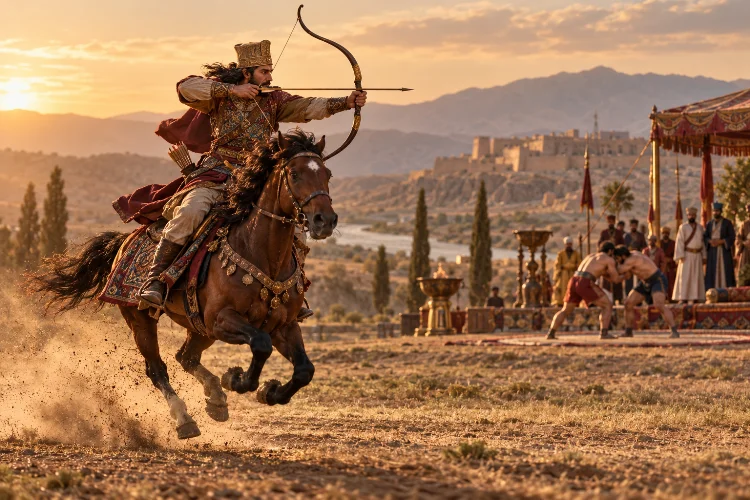
Long before modern gyms, professional leagues, and international sporting federations appeared, Persian society already placed serious value on riding, archery, wrestling, physical conditioning, and competitive games.
These activities were not always “sports” in the modern sense. Many developed from military preparation, royal education, community rituals, or ideas about personal character.
Yet several Persian sporting traditions survived for centuries, spread into other cultures, or evolved into forms that still look surprisingly familiar today.
The influence is especially clear in polo, whose Persian form, chogān, has a documented history stretching back more than 2,000 years.
Other traditions, including wrestling and strength exercises associated with pahlavani culture, helped preserve a distinctive Iranian approach to athletic development built around power, endurance, discipline, and moral behavior.
Understanding how ancient Persian sporting traditions influenced modern athletics therefore requires looking beyond individual games. Their deeper legacy lies in the combination of physical skill, specialized training, competition, horsemanship, and character.
Physical Training Was Part of Persian Education
Ancient Persian physical education was closely connected with preparation for adult responsibilities, especially warfare and horsemanship.
The Greek historian Herodotus famously wrote that Persian boys were taught three main skills: riding, archery, and telling the truth.
Whatever limitations an outside Greek observer may have had, his account shows how strongly physical ability and moral education were associated in descriptions of Achaemenid Persian society.
Horse control and archery were particularly practical abilities.
A mounted soldier needed balance, leg strength, coordination, quick reactions, and the ability to perform technically difficult actions while moving at speed. These are qualities that modern sports scientists might classify under agility, stability, power, and motor control.
The Persian model was therefore not simply about becoming physically strong. Athletic preparation was connected with usefulness, discipline, and skill.
That concept feels very modern. Today’s athletes rarely train muscles in isolation; they develop movement patterns that help them perform particular tasks.
Chogān Created One of Persia’s Clearest Sporting Legacies
The strongest direct connection between Persian sporting traditions and a modern international sport is probably chogān, an early form of mounted ball competition closely related to polo.
UNESCO describes chogān as a traditional Iranian horse-riding game with more than 2,000 years of history.
Two teams ride horses and attempt to drive a ball through their opponents’ goal posts using wooden sticks. Historically, the game was particularly associated with royal courts and urban playing fields.
Chogān was more than entertainment.
Persian equestrian traditions also treated polo as useful preparation for cavalry. Historical manuals described the game as a way for riders to learn horse control, rapid maneuvering, coordination, and the handling of equipment at speed.
The game spread across a wide geographical area over centuries.
Versions appeared in Central and South Asia and elsewhere. In nineteenth-century India, British officers encountered regional polo traditions, developed more standardized rules, and helped spread the modern game internationally through the British Empire.
Modern polo is therefore the product of a long multicultural developement rather than a sport that moved unchanged from ancient Persia to the present.
Still, Persian chogān represents one of its major historical roots.
Horsemanship Blended Sport With Military Skill
Horses played an enormous role in Persian military and elite culture, making equestrian skill a natural area for competition.
Encyclopaedia Iranica traces references to Persian horse racing back to the Achaemenid period, including Xenophon’s description of races associated with Cyrus.
Persian sporting culture also developed activities involving polo, mounted archery, javelin throwing, and elaborate displays of riding skill.
These activities rewarded abilities that remain central to modern equestrian sport: balance, communication with the horse, timing, confidence, and precise control at speed.
Later Iranian riders became famous for demanding displays such as firing arrows while galloping or throwing javelins from horseback. Such activities blurred the line between military drill and competitive performance.
We should not claim that modern show jumping, dressage, or Olympic equestrian events directly descended from Persian competitions.
Their formal rules developed through different historical traditions.
The connection is broader. Persian sporting culture helped establish a long-standing idea that advanced horsemanship could be trained, displayed, compared, and celebrated as a mark of athletc excellence.
Wrestling Became a Core Part of Iranian Athletic Identity
Wrestling has deep roots across western and central Asia, including Iran.
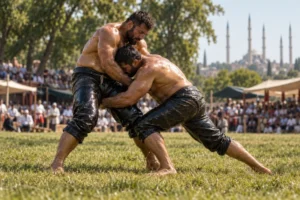
Over time, Persian wrestling became connected with the figure of the pahlavān: an athlete expected to possess physical strength alongside courage, generosity, and honorable behavior.
This tradition eventually became closely associated with the zurkhaneh, literally the “house of strength.”
The institution in its recognizable form developed much later than the Achaemenid or Sasanian empires, probably through medieval and early modern wrestling culture. It should therefore not be presented as an unchanged ancient Persian gym.
However, it preserved and reorganized older ideals of heroic athleticism.
For centuries, wrestling was the climactic competitive activity in many zurkhaneh sessions. Wrestlers developed power and conditioning before testing themselves through grappling.
Traditional Pahlavani wrestling remains alive today.
United World Wrestling recognizes Pahlavani as an associated wrestling style, and Iranian championships continue using modern categories while preserving important elements of the traditional discipline.
This continuity helps explain why wrestling occupies such a significant place in Iranian sporting culture even in the modern Olympic era.
The Zurkhaneh Resembles Modern Functional Training
Walk into a traditional zurkhaneh and some exercises may look unexpectedly familiar to anyone who follows modern strength training.
Athletes perform push-up variations, rotations, calisthenics, and resistance exercises using specialized equipment.
Heavy wooden clubs called mil are swung around the body. Large wooden shields known as sang are lifted while lying on the back, while the kabbāda, a heavy iron bow-shaped implement, develops upper-body strength and control.
These tools symbolically represent weapons.
UNESCO describes Pahlevani training as a combination of gymnastic and calisthenic movements performed with instruments representing ancient arms.
Training takes place inside the sunken central area of the zurkhaneh, often accompanied by rhythmic drumming and epic poetry.
It would be inaccurate to call the zurkhaneh the direct ancestor of today’s gym.
Modern strength and conditioning developed from many independent traditions.
Still, the parallels are striking.
Club swinging resembles modern Indian-club and mace training. Push-ups develop bodyweight strength, while repeated rotations, loaded movements, and rhythmic sequences combine conditioning with mobility.
In modern fitness language, much of this could easily be described as functional training.
Strength Was Supposed to Come With Character
One feature that separates traditional Pahlavani culture from a purely performance-based training system is its ethical dimension.
Becoming physically powerful was not considered enough.
Athletes were expected to demonstrate humility, courage, respect, community responsibility, and generosity.
UNESCO notes that students are taught ethical and chivalrous values under senior champions, while achieving the respected title of pahlavān traditionally involved both physical mastery and moral expectations.
This tradition became associated with the Persian concept of javānmardi, often translated roughly as chivalry or honorable conduct.
Persian wrestling culture therefore created an ideal athlete who was measured not only by whether he could defeat another competitor, but also by how he behaved outside competition.
The comparison with modern sportsmanship is obvious.
Today’s sporting organizations promote respect, fair play, leadership, and responsibility alongside competitive success. Those principles did not originate exclusively in Persia, of course.
But Persian athletic traditons provide an old example of a culture intentionally connecting sporting excellence with personal character.
Traditional Training Adapted to Modern Sporting Systems
The arrival of international sports during the nineteenth and twentieth centuries did not simply erase Persian physical culture.
Instead, traditional forms frequently adapted.
Encyclopaedia Iranica notes that the older rank structure of zurkhaneh athletes gradually gave way to standardized categories such as cadet, junior, and senior.
Pahlavani wrestling also adopted weight classes as Iranian athletes increasingly participated in modern international wrestling.
This created an interesting overlap.
Iranian wrestlers could participate in globally standardized freestyle or Greco-Roman competition while still belonging to a culture influenced by traditional wrestling ideals.
Golam Reza Takhti offers a famous twentieth-century example.
Takhti won Olympic and world titles in freestyle wrestling while also competing successfully in traditional Pahlavani wrestling. His reputation in Iran ultimately rested on both athletic success and the heroic ethical qualities associated with the pahlavān ideal.
The result was not a simple replacement of ancient sport by modern sport.
It was a blending of international competition with local athletic identity.
Persian Sports Also Encouraged Specialized Athletic Skills
Historical Persian sources mention a surprisingly wide range of physical games.
Middle Persian literature refers to activities involving arrows, javelins, swords, clubs, ball games, rope walking, and polo. Some were entertainment, others were military exercises, and some served both purposes.
This variety matters because modern athletics is built around specialization.
Different athletes develop different combinations of speed, strength, endurance, coordination, precision, and tactical awareness.
Persian sporting culture recognized the same basic reality.
An expert horseman required different abilities from a wrestler. An archer depended on precision and control, while a club athlete needed upper-body endurance and rhythm.
Physical excellence therefore had multiple forms.
That idea seems obvious today because modern sport contains hundreds of disciplines. Historically, however, cultures such as Persia helped demonstrate that athletic skill could extend far beyond simple running or brute strength.
The Influence on Modern Athletics Should Not Be Overstated
It is tempting to draw a straight line from every ancient sporting activity to a modern equivalent.
History rarely works that neatly.
Modern wrestling rules were shaped by international federations. Contemporary strength training incorporates European gymnastics, weightlifting, sports science, bodybuilding, and numerous other systems.
Modern polo took its current standardized form largely through developments in South Asia and British sporting institutions.
Persian sport was one influence among many.
Yet some connections are undeniable.
Chogān contributed directly to the much larger historical family from which modern polo emerged. Pahlavani wrestling remains a living competitive discipline.
Zurkhaneh exercises continue to preserve traditional resistance and conditioning methods, while Iranian wrestling culture still celebrates the older ideal of the honorable champion.
The real legacy is therefore not that Persia “invented modern athletics.”
It is that Persian civilization developed durable sporting ideas – training for specific skills, combining competition with character, using sport for military preparation, and celebrating specialized athletes – that remain easy to recognize in modern sporting culture.
Ancient Persian sporting traditions influenced modern athletics through a mixture of direct inheritance, cultural survival, and long-term adaptation.
Chogān offers the clearest example, helping form the historical foundations of modern polo. Persian horsemanship emphasized balance, speed, control, and precision, while wrestling traditions eventually became closely connected with Pahlavani culture and the zurkhaneh.
Its club swinging, bodyweight exercises, resistance training, and rhythmic conditioning still resemble several ideas used in functional fitness today.
Just as importantly, Persian athletic culture connected physical ability with discipline and honorable behavior.
The details have changed dramatically, but the central idea remains familiar: a great athlete needs more than raw strenght.
Explore chogān, Pahlavani wrestling, or traditional zurkhaneh training today, and you can still see parts of that centuries-old sporting philosophy in action.