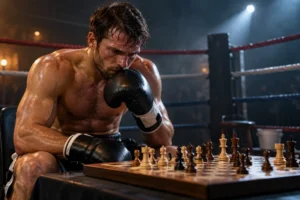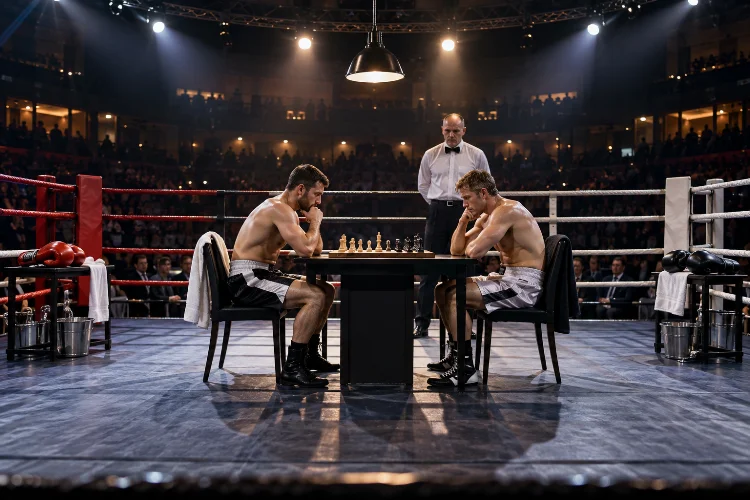
Watching a chess boxing match for the first time can be confusing. One moment, two competitors are sitting quietly over a chessboard. A few minutes later, the board disappears, boxing gloves go on, and those same players are exchanging punches inside the ring.
Then they return to the chessboard as if nothing happened.
That contrast is the foundation of the competitive structure of chess boxing matches. Instead of combining chess and boxing into one continuous activity, the sport alternates between separate rounds of each discipline.
The chess game continues from where it previously stopped, while the boxing rounds follow modified combat-sport rules.
Modern formats are not identical everywhere. The traditional WCBO structure allows a maximum of 11 rounds – six chess and five boxing – while organizations and promoters today may use shorter five- or seven-round bouts.
Understanding that structure makes chess boxing much easier to follow. Every round creates another opportunity to win, but it also changes the strategy for everything that comes next.
Chess Boxing Always Alternates Between Two Disciplines
The central rule is wonderfully simple: competitors alternate between chess and boxing.
A bout begins with chess. After that comes boxing, then chess again, continuing according to the event’s chosen format.
Under the traditional WCBO amateur rules, a full-length contest can contain a maximum of 11 rounds: six chess rounds and five boxing rounds. Each round lasts three minutes, although junior boxing rounds can be shorter. There is normally a one-minute break between disciplines.
But modern promoters sometimes prefer shorter contests.
Chessboxing Czechia, for example, currently describes a five-round standard format consisting of three chess rounds and two boxing rounds. Its seven-round main-event structure includes four chess rounds and three boxing rounds. Both begin and finish with chess.
The French ChessBoxing Federation similarly recognizes multiple formats, including five, seven, and eleven rounds.
So there is no single round count that defines every chess boxing event.
The alternating structure is the essential part.
The Chess Game Does Not Restart After Every Boxing Round
One of the most important details for new spectators is that competitors are playing one continuous chess game.
When a chess round ends, the board position is preserved.
The competitors enter their boxing round, fight, return to the table, and resume from exactly the same position. The chess clock also continues according to the time each player has remaining.
This creates fascinating tactical situations.
Imagine one competitor ends a chess round facing a dangerous attack. They cannot immediately solve the problem because they first have to survive several minutes of boxing.
During that physical round, they may already be thinking about the chess position.
When they sit down again, however, fatigue and an elevated heart rate can make calculating the correct continuation much harder.
The board therefore creates a storyline that develops throughout the entire bout rather than several unrelated miniature games.
Chess Clock Management Is Part of the Competition
Chess boxing typically uses rapid or blitz-style chess rather than the slower time controls seen in traditional tournament chess.
That is necessary because a match must fit multiple chess sessions between boxing rounds.
At current Czech events, chess rounds last three minutes, and the competitors play using a digital clock. Players must make their move and press the clock with one hand. Outside assistance is prohibited.
Running out of chess time can immediately decide the entire bout.
This produces another layer of strategy.
A player with a strong position but only a few seconds remaining may actually be in greater danger than an opponent with a weaker position and plenty of clock time.
Competitors therefore have to manage two resources simultaneously: the position on the board and the seconds available to play it.
Deliberate stalling is also discouraged. Under some current competition rules, the chess arbiter can begin a countdown when a player is intentionally refusing to move, preventing someone from simply wasting time until another boxing round arrives.
Boxing Rounds Create a Completely Different Route to Victory
The boxing portion usually follows modified amateur boxing regulations.
Competitors wear appropriate protective equipement and must obey familiar restrictions against illegal techniques such as low blows, elbows, headbutts, and punches to the back of the head.
A boxing referee controls these rounds, while separate officials supervise the chess game and timing.
A knockout can immediately end the chess boxing contest.
So can a technical knockout or referee stoppage under applicable event rules.
This creates a unique strategic problem.
A competitor may be losing badly on the chessboard but dominating physically. Instead of trying to rescue an almost hopeless chess position, their best chance may be increasing pressure during the next boxing round.
The reverse is equally true.
A talented chess player who is struggling physically may use defensive boxing, movement, and clinch management to survive long enough to reach the board again.
Neither discipline exists independently.
Success in one changes how aggressively the athlete needs to approach the other.
There Are Several Ways to Win a Chess Boxing Match
Unlike most sports, chess boxing offers victory conditions from two completely different rule systems.
A competitor can win through checkmate, by causing the opponent to run out of chess time, by knockout or technical knockout, through resignation or retirement, or through disqualification depending on the event.
That variety creates unusual match dynamics.
Suppose Fighter A is clearly ahead on the chessboard but exhausted after several boxing rounds. Fighter B may realize that waiting for the next chess round is dangerous and begin attacking much more aggressively in the ring.
Alternatively, Fighter B might be physically dominant but running extremely low on chess time.
Suddenly every second spent calculating matters.
Because the contest can end in either discipline, competitors always have to understand the overall situation rather than thinking only about the current round.
This is what makes chess boxing much more than simply placing chess and boxing next to each other.
What Happens When the Chess Game Ends in a Draw?
Draw procedures are one area where competition formats can differ.
Under the current format described by Chessboxing Czechia, if the chess game ends in a draw, boxing points determine the winner. If the boxing score is also level, the competitor who had the black chess pieces wins because Black began the game without the first-move advantage.
Other organizations can handle draws differently.
The Swiss Chessboxing Federation, for example, states that judges confer to determine the winner when necessary.
This variation is another reason spectators should check the rules of a particular event rather than assuming every promotion operates identically.
Chess boxing is still a relatively young sport compared with traditional boxing or organized chess, and different federations have developed slightly different competitive systems.
The important principle remains consistent: organizers need a mechanism to produce a final winner even when the chess game itself does not.
Weight Classes Help Keep the Boxing Side Fair
Chess skill does not depend much on body weight.
Punching certainly does.
For that reason, competitive chess boxing generally uses weight divisions just like conventional combat sports.
Published professional chess boxing structures have historically included separate lightweight, middleweight, light-heavyweight, and heavyweight divisions, with different limits for men and women. Amateur systems may use narrower weight increments.
Weight matching is essential because physical size can dramatically affect punching power, durability, reach, and grappling inside close boxing exchanges.
But organizers have another difficult matching problem.
Two competitors should ideally also have reasonably compatible chess abilities and boxing experience.
Imagine matching a professional-level boxer who barely knows chess against a tournament chess expert with almost no boxing background. The contest might become extremely one-sided depending on which discipline produces the first decisive opportunity.
Good matchmaking therefore involves more than putting athletes into the same weight category.
It tries to create a contest where both parts actually matter.
Different Officials Control Different Parts of the Match
Chess boxing requires a more complicated officiating team than many spectators expect.
A boxing referee cannot simply supervise everything.
The chess rounds require an arbiter who understands chess rules, illegal moves, the clock, stalling, and checkmate situations. Boxing requires a qualified referee focused on safety and legal striking.
A timekeeper also manages round durations and transitions. Judges may be needed for boxing scoring, while event officials coordinate the overall contest.
This separation is logical because the sports operate under completely different rule systems.
The chess arbiter needs to concentrate on the board.
The boxing referee needs to watch punches, knockdowns, defensive behavior, and athlete safety.
Switching between those environments also creates logistical challenges. Within roughly a minute, athletes may need to leave the board, put on gloves and other equipment, receive instructions from their corners, and prepare to fight.
Then the process reverses.
The transition itself becomes part of the competiton.
The One-Minute Transition Is More Important Than It Looks
A minute sounds like plenty of time until you have just finished boxing.
During the transition, competitors must change equipment and mentally shift from combat to calculation.
Modern Czech rules provide one minute between rounds.
That short break helps create chess boxing’s distinctive difficulty.
After a chess round, an athlete must raise their physical intensity almost immediately. After boxing, they have to do the opposite – control breathing, reduce emotional arousal, and sit down to calculate.
Strong chess boxers practise this transition rather than treating it as empty recovery time.
A competitor might use controlled breathing after boxing so their heart rate begins dropping before the chess clock resumes.
They also need to remember what was happening on the board.
Was a knight under attack? Was there a tactical threat against the king? How much time remained?
Losing track of one small detail during the physical round can produce an immediate chess blunder.
Match Strategy Depends on Relative Strengths
Perhaps the most interesting part of the competitive structure is that athletes can build strategies around their strongest discipline.
A superior chess player may seek complicated positions and push for an early checkmate.
During boxing rounds, the same athlete might compete conservatively, focusing on defense and avoiding unnecessary exchanges.
A stronger boxer may do the opposite.
They might play solid, low-risk chess simply to survive each chess session, then increase pressure in the ring.
The match situation can force those plans to change.
If the stronger boxer unexpectedly loses material on the chessboard, they may become much more aggressive physicaly because a knockout is now their clearest path to victory.
If the chess specialist suffers a knockdown, simplifying the chess position may become less useful than launching an immediate tactical attack.
This constant interaction means competitors are not really managing two separate games.
They are managing one strategic contest with two different battlefields.
Chess Boxing’s Structure Developed With the Modern Sport
Modern chess boxing became organized in 2003 through Dutch performance artist Iepe Rubingh, who was inspired by Enki Bilal’s graphic novel Froid Équateur.
Rubingh’s crucial innovation was alternating chess and boxing rather than conducting them as completely separate contests. He organized an early public performance in Berlin and later the first official WCBO competition in Amsterdam on November 14, 2003.
That inaugural championship reportedly reached its eleventh round.
Interestingly, the result demonstrated exactly why chess clock management matters: Jean-Louis Veenstra reportedly held the stronger position but ran out of time, making Rubingh the winner.
Since then, promoters have experimented with shorter formats while preserving alternating rounds as the central principle.
Five-, seven-, and eleven-round structures now demonstrate how the sport can adapt its length without losing its identity.
Understanding the competitive structure of chess boxing makes the sport far easier – and more interesting – to follow.
A match alternates chess and boxing, with the same chess game continuing between physical rounds.
Depending on the organization, contests may use five, seven, or as many as eleven rounds. Competitors can win through checkmate, the chess clock, knockout, technical stoppage, resignation, or other rule-based outcomes.
Weight divisions protect fairness in the ring, while chess arbiters, boxing referees, and timekeepers manage different parts of the contest.
Most importantly, every round affects the strategy of the next one.
If you watch a chess boxing bout, don’t focus only on punches or brilliant chess moves. Watch the clock, the transitions, and each athlete’s relative strengths. That is where the real structure – and much of the strategy – becomes visible.