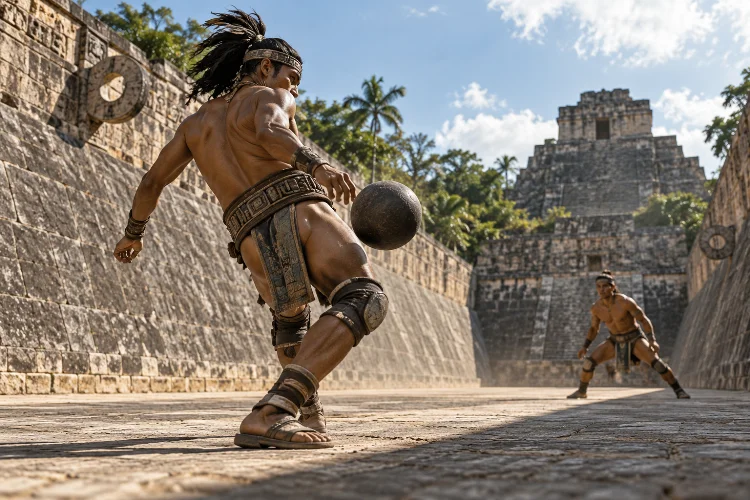
Imagine playing a competitive sport with a solid rubber ball that can weigh several kilograms, while being forbidden from simply grabbing it with your hands.
Instead, you may have to strike it with your hips, thighs, shoulders, or forearms while trying to keep it moving across a stone court.
That was one form of the ancient Mesoamerican ballgame, one of the longest-lived sporting traditions in the Americas.
Evidence for the game stretches back more than 3,000 years. Archaeologists have identified an early ballcourt at Paso de la Amada dating to around 1400 BCE, while rubber balls discovered at El Manatí may date to roughly 1600 BCE.
But talking about the historical rules of the Mesoamerican ballgame is complicated. There was no single standardized version used everywhere. Maya, Mexica, Veracruz, Zapotec, and other communities developed different forms across centuries.
That variation is exactly what makes its competitive history so fascinating.
There Was Never One Universal Mesoamerican Ballgame Rulebook
The first rule to understand is that there was no universal set of rules.
Mesoamerica covered a huge region extending through much of present-day Mexico and Central America. The ballgame survived across numerous cultures for thousands of years, so techniques naturally changed according to time and place.
The Metropolitan Museum of Art notes that rules differed significantly across the region.
Some versions emphasized keeping the ball continuously in motion, while others involved stone markers, painted court lines, wall targets, or rings. In certain areas, players even used wooden paddles.
Team size also varied.
Artistic representations show teams of two or more players, while other historical reconstructions suggest larger groups could participate. Mexico’s National Institute of Anthropology and History describes versions involving teams ranging from one to seven players.
It is therefore better to think of the Mesoamerican ballgame as a family of related sports rather than one fixed game.
Players Usually Could Not Simply Catch the Ball
One of the most distinctive rules involved how the ball could be struck.
In the famous hip-ball version, players generally could not grab or throw the ball with their hands. Instead, they redirected the heavy rubber sphere primarily with the hips and torso.
Maya art frequently shows athletes positioning their bodies to strike the ball with the hip. Sixteenth-century descriptions of Mexica play also mention contact with areas such as the thighs and upper arms.
INAH describes versions where the hip was the main striking surface, although forearms, shoulders, and the back could also be used. Hands and feet were prohibited in the version it describes.
This immediately made the sport technically difficult.
A player could not simply chase the ball and pick it up. They had to anticipate its bounce, rotate their body, and strike it using a relatively awkward surface.
Considering that some solid rubber balls could weigh several kilograms, mistiming that movement probably hurt considerably.
Keeping the Rubber Ball Moving Was a Central Challenge
The rubber ball itself shaped the rules.
Unlike inflated modern footballs or basketballs, Mesoamerican balls were made from solid rubber. Ancient communities produced rubber using latex from native trees, developing a material capable of creating a strong bounce.
One major objective, particularly in historically recorded Mexica versions, was keeping the ball in continuous movement.
That makes comparisons with volleyball or racquet sports understandable, although none is an exact match.
Players sent the ball toward the opposing side and used the architecture of the court to help redirect it. Sloping walls could send the ball back toward the central playing area, creating unpredictable angles.
Allowing the ball to become dead or failing to return it could influence scoring, depending on the local rules.
This demanded more than raw strength. Good particpants needed reaction speed, timing, body control, and the ability to judge how a heavy rubber ball would rebound from stone or plaster surfaces.
Stone Rings Were Important, but They Were Not Everywhere
Perhaps the most famous image of the Mesoamerican ballgame is a player somehow sending a rubber ball through a vertical stone ring mounted high on a wall.
Stone rings certainly existed, but they were not a universal feature.
INAH notes that tlachtemalácatl, the stone rings associated particularly with Nahua ballcourts, appeared only on some courts.
Passing the ball through one was considered an exceptional feat and, according to historical sources from central Mexico, could determine the outcome immediately.
That distinction matters.
Movies and modern recreations sometimes make the ring appear to be the equivalent of a basketball hoop – the standard target of every ancient match. Archaeological evidence shows a much more differnt picture.
Earlier courts could function without rings at all.
Competitors might instead earn advantages through rallies, end lines, wall contact, floor markings, or stone markers. INAH describes versions in which points could result when the ball struck particular areas or crossed an opponent’s boundary.
So getting the ball through a stone ring was spectacular, but it should not be treated as the only historical scoring method.
Ballcourt Architecture Was Part of the Game
The court was not simply an empty rectangle.
More than 1,500 Mesoamerican ballcourts have been identified according to INAH, demonstrating just how widespread the tradition became.
Many courts had a long central alley surrounded by raised structures or sloping walls. Seen from above, enclosed examples often resembled a capital letter I.
Their sizes varied considerably.
The Great Ballcourt at Chichén Itzá, for example, measures roughly 96.5 metres long and 30 metres wide, making it the largest well-known surviving example. Other communities built much smaller spaces.
Architecture could directly influence strategy.
Sloping surfaces changed the ball’s trajectory, while court markers and walls could have competitive functions. Players therefore needed to understand not only their opponents but also how the local arena behaved.
In that sense, playing on different ancient courts might have felt slightly like modern athletes adjusting to different surfaces, stadium dimensions, or environmental conditions.
Protective Equipment Was Necessary, Not Decorative
Getting hit by a solid rubber ball at speed could be dangerous.
Players therefore wore protective clothing around areas likely to absorb repeated impacts.
Artworks show equipment around the waist and hips, along with knee pads, arm protection, and other forms of padding. A surviving Tlapacoya ballplayer figure, for example, depicts extensive protective gear around several vulnerable parts of the body.
The famous U-shaped objects often called yokes are particularly interesting.
Heavy stone yokes found in museums were probably ceremonial versions rather than equipment worn during an actual match.
Archaeological research suggests practical versions may have been constructed from lighter materials such as leather, cloth, wood, or other perishable substances.
The equipment tells us something important about the rules.
This was a sport based on deliberate body contact with a hard projectile. Protection was not optional decoration; it helped athletes repeatedly absorb the forces required by the game.
Scoring Could Be More Complicated Than Modern Reconstructions Suggest
Researchers cannot reconstruct a universal scoring system with complete confidence.
Spanish colonial descriptions provide information about later forms of the sport, but the tradition was already thousands of years old by the time those observers arrived.
Different societies may have awarded points for different actions.
INAH describes scoring connected with the ball striking particular walls or crossing an opponent’s end line, while a successful shot through certain stone rings could immediately decide a match.
Other archaeological evidence points toward floor markers and painted lines potentially influencing play.
The safest historical conclusion is therefore that scoring depended heavily on the variant being played.
Trying to write one neat modern-style rulebook for every Maya, Mexica, or Veracruz ballgame would create a false sense of precision.
The surviving evidence instead reveals a remarkably adaptable competitive tradition.
Gambling Made Some Matches High-Stakes Events
Not every ballgame was purely ceremonial.
Sport, entertainment, prestige, politics, and gambling could overlap.
Historical evidence indicates that gambling became particularly significant in Mexica society. Spectators could wager valuable possessions on results, creating another layer of excitement around major matches.
That makes the social atmosphere surprisingly recognizable.
Crowds gathered, supported competitors, reacted noisily, and sometimes had something valuable riding on the result.
One Maya vessel even depicts visual symbols interpreted as speech coming from people around a game, while other evidence suggests instruments such as conch shells may have accompanied proceedings.
Elite participation was especially visible in surviving art, although the game was probably not restricted exclusively to rulers and nobles.
Ballcourts themselves often occupied important locations close to ceremonial or political centers, reinforcing the sport’s status within public life.
Did the Losing Team Really Get Sacrificed?
This is probably the most famous – and most misunderstood – question surrounding the game.
Human sacrifice was genuinely associated with Mesoamerican ballgame traditions.
Stone reliefs at sites including Chichén Itzá and El Tajín show sacrifice and decapitation connected with ballcourt imagery. Mythological traditions also link the game with death, the underworld, and regeneration.
But that does not prove that every losing team was automatically killed.
Researchers still debate exactly who was sacrificed, under what circumstances, and how sacrifice related to particular games. The Metropolitan Museum explicitly notes that the precise mechanism remains unclear.
Some contests may have involved captives, ritual reenactments, political symbolism, or ceremonies that differed greatly from ordinary competitive games.
So the popular statement “the losers were sacrificed” is much too simple.
Sacrifice belonged to the cultural world surrounding some forms of the ballgame, but it should not be treated as a universal post-match rule.
The Ballgame Was Sport, Ritual, and Political Theatre
Modern sports are often separated into neat categories: entertainment, athletics, religion, or politics.
Mesoamerican societies did not necessarily separate these activities in the same way.
The ballgame could function as physical competition while also expressing ideas about cosmic order, warfare, agricultural fertility, rulership, and the relationship between life and death.
Ballcourts were frequently placed within ceremonial centers, close to temples and politically important structures.
Maya mythology provides one famous example.
In the Popol Vuh, ballgames form part of the story of heroic brothers confronting the Lords of Xibalba, the underworld. This strengthened associations between ball play, death, rebirth, and cosmic struggle.
At the same time, people could simply enjoy watching competitive matches.
That combination is what makes the sport historically remarkable: it could be a game and something far more symbolic at the same time.
The Tradition Did Not Completely Disappear
European colonization dramatically changed Mesoamerican societies, but forms of the ancient ballgame survived.
One important descendant is ulama, still associated especially with communities in northwestern Mexico.
Modern variants can use the hip, forearm, or implements, preserving elements of a sporting tradition with extremely deep historical roots.
INAH describes contemporary hip-ulama teams using a defined scoring system and referees while still displaying important regional differences.
Modern versions should not be treated as perfect replicas of games played 2,000 years ago.
However, they offer rare evidence of cultural continuty.
Unlike many ancient sports known only from texts, monuments, or archaeological remains, the basic idea of striking a rubber ball according to inherited Mesoamerican traditions remains alive.
Exploring the historical rules of the Mesoamerican ballgame reveals a sport far more complex than the familiar image of players trying to hit a rubber ball through a stone ring.
Rules varied enormously across centuries and regions.
Players commonly struck solid rubber balls with their hips or other permitted body areas, used protective equipment, navigated specially designed courts, and followed scoring systems that could involve boundaries, walls, markers, or occasionally stone rings.
Just as importantly, competitive play existed alongside gambling, political prestige, mythology, religion, and sometimes sacrifice.
There was no single ancient rulebook – and that diversity is part of what makes the tradition extraordinary.
If ancient sports interest you, explore the surviving ballcourts and artwork from Chichén Itzá, El Tajín, Monte Albán, and other Mesoamerican sites. Each one adds another piece to the story of one of history’s oldest competitive traditions.