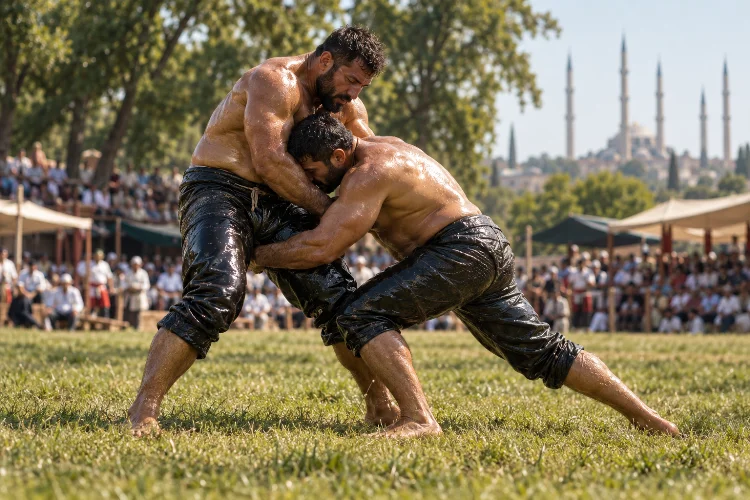
Imagine trying to wrestle someone who has been completely covered in olive oil. Every normal grip becomes unreliable, your opponent can slip away in an instant, and winning suddenly depends on balance, timing, endurance, and some very unusual techniques.
That is the basic challenge behind traditional Turkish oil wrestling, or yağlı güreş.
The sport is most famously associated with the Kırkpınar Oil Wrestling Festival in Edirne, Turkey. Its traditional history stretches back to the early Ottoman period, and today Kırkpınar remains one of the world’s best-known surviving wrestling festivals.
In 2010, UNESCO added the festival to its Representative List of the Intangible Cultural Heritage of Humanity.
Yet Turkish oil wrestling is much more than two powerful men struggling on grass. Its leather trousers, olive oil, music, prayers, master-apprentice training, ceremonies, and ideas about honorable behavior reflect centuries of cultural development.
Understanding those historical roots helps explain why Kırkpınar remains both a serious athletic competiton and a living cultural tradition.
Wrestling Had Deep Roots in Turkish Warrior Culture
Wrestling occupied an important place in Turkic societies long before Kırkpınar became famous.
Physical strength had practical value in communities where horsemanship, military ability, and close combat were highly respected. Wrestling offered a direct way for men to test strength, balance, toughness, and technique without requiring elaborate equipment.
Over time, the successful wrestler became associated with the idea of the pehlivan.
The word itself has Persian roots and historically carried meanings extending beyond someone who simply wrestled.
Turkish cultural sources associate the pehlivan with courage, physical power, honesty, generosity, and honorable conduct. Early Ottoman and Seljuk usage could even connect the term with heroic warriors.
This distinction became important.
A talented athlete might be physically strong, but the ideal pehlivan was expected to demonstrate character as well. That ethical dimension still forms part of the cultural identity surrounding Kırkpınar today.
The Kırkpınar Origin Story Goes Back to the Early Ottoman Era
The traditional story of Kırkpınar begins during Ottoman expansion into the Balkans in the fourteenth century.
Different versions vary in dates and details, which is why the story should be treated as a cultural origin narrative rather than a perfectly documented historical report.
According to a widely repeated tradition, a group of forty Ottoman warriors began wrestling during a military campaign in Rumelia.
Two particularly strong competitors continued fighting for hours without establishing a winner. Later versions of the story say they eventually died from exhaustion and were buried near the place where they had wrestled.
When their companions returned, springs were supposedly flowing near their graves. The place became associated with Kırkpınar, often interpreted as “forty springs.”
Turkey’s Culture Portal connects the establishment of the continuing festival tradition with the Ottoman conquest of Edirne in the 1360s and commemorations of the warriors.
Whether every detail happened exactly this way is uncertain.
What matters culturally is that the legend connects oil wrestling with Ottoman frontier history, brotherhood, endurance, and heroic competition.
Why Wrestlers Cover Themselves in Olive Oil
The most obvious difference between oil wrestling and conventional wrestling is, naturally, the oil.
Before competing, pehlivans coat their bodies with olive oil. UNESCO describes an oil man applying oil before the wrestlers complete their warm-up exercises and ceremonial greetings.
The oil completely changes wrestling technique.
In ordinary grappling, athletes can secure relatively firm holds around arms, shoulders, or the torso. An oiled opponent is much harder to control.
Hands slide across the skin, forcing competitors to rely more heavily on leverage, body positioning, balance, leg attacks, and control of the opponent’s leather trousers.
The precise historical reason olive oil became central to the sport is less certain than popular stories sometimes suggest.
Its practical effect, however, is obvious: it makes wrestling dramatically more difficult.
There is also an important cultural element. Historical research into Kırkpınar traditions notes that wrestlers traditionally helped oil one another before competing. Making your opponent equally difficult to grip reinforces the idea of fair contest and mutual respect.
The Kispet Became the Symbolic Uniform of the Pehlivan
A Kırkpınar wrestler does not wear a modern wrestling singlet.
Instead, he competes in a pair of heavy leather trousers known as a kispet or kıspet. UNESCO describes them as traditionally made from water buffalo or cow leather.
The trousers extend from the waist to below the knees and are tightly secured around the body.
They serve both practical and symbolic purposes.
Because the wrestler’s upper body is covered in oil, the kispet provides one of the few areas where meaningful control can be established. Wrestlers may grip or reach into permitted areas of the leather garment as part of traditional techniques.
Producing a proper kispet also developed into a specialized craft transmitted between generations.
Academic research describes ceremonies historically associated with receiving and wearing the garment, combining athletic identity with Turkish and Islamic traditions.
Even the woven bag used to carry it has meaning. Known as a zembil, it traditionally stored the oiled leather and could symbolize the relationship between master and apprentice. The Turkish phrase equivalent to “hanging up the zembil” came to represent retirement from wrestling.
Ottoman Culture Turned Wrestling Into a Major Public Tradition
As the Ottoman Empire developed, wrestling became more organized.
Pehlivans could train under experienced masters, travel to festivals, and build reputations through competitive success. Some wrestling environments combined physical instruction with moral and spiritual education.
Research on Kırkpınar describes historical wrestling schools or tekke traditions where athletes developed both physical ability and expected standards of conduct.
This helped transform wrestling from an informal test of strength into a recognized athletic profession.
Successful pehlivans could become famous well beyond their own communities.
During the nineteenth century, wrestlers such as Koca Yusuf, Kara Ahmet, and other Ottoman champions gained international reputations. Some eventually traveled to Europe and North America, where they competed against wrestlers from different traditions.
Their success introduced international audiences to Turkish grappling culture while also exposing Ottoman athletes to new styles and rules.
Traditional oil wrestling nevertheless remained distinct from the Greco-Roman and freestyle formats that later became standardized international sports.
The Festival Is Much More Than the Actual Wrestling
A visitor arriving at Kırkpınar encounters much more than a tournament bracket.
The festival includes music, procession, prayer, introductions, traditional clothing, sponsorship, and specific ceremonial roles.
Before wrestling begins, the cazgır, or master announcer, introduces competitors through rhythmic speech and prayer. The pehlivans then perform a traditional warm-up known as the peşrev before entering combat.
Drums called davul and wind instruments known as zurna provide the traditional soundtrack.
UNESCO also highlights the role of the Kırkpınar Ağa, the festival’s patron. Historically, the Ağa was much more than a sponsor. He helped organize the event, invited wrestlers and important guests, and could even assist visitors with food and accommodation.
These cerimonies demonstrate why calling Kırkpınar simply a wrestling competition misses much of its cultural importance.
The matches are the central attraction, but the surrounding rituals turn them into a community festival.
Wars Forced Kırkpınar to Change Location
Another fascinating part of the festival’s history is that Kırkpınar survived major political and geographic changes.
The traditional wrestling grounds were located in Rumelia, in territory that would eventually fall outside the borders of modern Turkey.
The Balkan Wars and later territorial changes made continuing the festival at its older location increasingly difficult. Historical accounts describe the wrestling event moving before becoming firmly established in Edirne.
Today, Kırkpınar is strongly identified with Edirne and the Sarayiçi area.
This relocation demonstrates an important feature of living traditions: survival often requires adaptation.
The geographic setting changed, governments changed, sporting institutions changed, and modern regulations were introduced. Yet wrestlers continued wearing kispet, applying oil, performing peşrev, and maintaining the pehlivan identity.
The tradition survived because its essential cultural elements could travel.
Winning the Golden Belt Became the Ultimate Honor
Modern Kırkpınar competitors fight for far more than a single victory.
The champion of the highest division receives the prestigious title Başpehlivan, or Chief Pehlivan, along with the Kırkpınar Golden Belt.
A wrestler who wins the championship three years consecutively can become the permanent owner of the belt under the festival tradition.
Interestingly, the current Golden Belt system is not itself medieval.
Turkey’s Culture Portal traces an earlier championship belt tradition to 1939, while the modern gold version was introduced by Edirne Municipality in 1960.
This is a useful reminder that traditions evolve.
Something can become an important symbol even if it was introduced centuries after the sport’s legendary beginnings.
The belt now connects modern competitive achievement with the prestige historically attached to becoming a respected pehlivan.
Technique Matters More Than Simple Size
Oil wrestling can look like a contest of brute force, but experience and technique are essential.
Because the athletes are slippery, maintaining control requires excellent balance and efficient body positioning. Wrestlers must know when to attack, when to conserve energy, and how to manipulate an opponent whose skin offers almost no reliable grip.
Endurance is particularly important.
Traditional matches could become extremely long, forcing competitors to manage strength carefully rather than attacking continuously.
The kispet also creates techniques that look unusual to spectators familiar with Olympic wrestling. Controlling the leather trousers can provide leverage when normal upper-body grips disappear.
Oil therefore changes the entire tactical logic of grappling.
A technically superior but somewhat smaller athlete may still frustrate a more powerful rival by controlling position, responding quickly, and exploiting mistakes.
That combination of strenght, endurance, patience, and skill helps explain why experienced masters have traditionally commanded so much respect.
UNESCO Recognition Helped Protect a Living Tradition
Kırkpınar entered a new phase of its history in 2010 when UNESCO inscribed the festival on the Representative List of the Intangible Cultural Heritage of Humanity.
UNESCO emphasized not only the wrestling itself but also the master-apprentice system, music, rituals, clothing, festival officials, and values associated with the pehlivan.
That distinction is important.
The heritage being protected is not simply a particular grappling technique.
It is an entire cultural ecosystem.
Craftspeople produce traditional clothing. Musicians preserve a characteristic repertoire. Announcers inherit ceremonial knowledge. Masters train younger wrestlers, while spectators and organizers help maintain an event connecting modern Turkey with generations of earlier participants.
In other words, Kırkpınar survives because many people participate in keeping it alive.
The historical roots of traditional Turkish oil wrestling stretch through warrior culture, Ottoman expansion, public festivals, master-apprentice training, and centuries of changing social conditions.
Kırkpınar’s legendary origins connect the competition with forty Ottoman warriors, while later generations developed the rituals that now define the sport.
Olive oil transformed grappling technique, the kispet became both practical equipment and cultural symbol, and the pehlivan came to represent not only strength but courage, fairness, and respect.
Even relocation, modernization, and international sporting rules failed to erase these traditions.
Today, Kırkpınar remains compelling precisely because it is both sport and heritage. If you ever watch a bout, pay attention to everything surrounding the wrestling – the oiling, music, peşrev, leather kispet, and ceremonies tell a story almost as fascinating as the match itself.