Running 250 metres sounds fairly easy for anyone with basic fitness. Now imagine doing it while carrying another adult, jumping over obstacles, navigating uneven ground, and plunging through a water section – all while racing against the clock.
That is essentially the challenge athletes face in Finland’s wife carrying races.
Known locally as eukonkanto, wife carrying might look like a humorous festival activity at first glance.
Beneath the costumes, cheering crowds, and unusual carrying positions, however, lies a surprisingly demanding athletic competition involving strength, speed, balance, coordination, and trust between partners.
The most famous event is the Wife Carrying World Championship in Sonkajärvi, Finland. The Finnish Championships began in 1992, while the World Championships followed in 1996. Today, the event attracts competitors and spectators from multiple countries.
So what does it actually take to race competitively while carrying another person? Much more than simply having strong arms.
Understanding Finland’s Wife Carrying Race
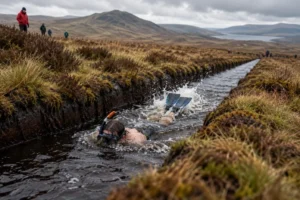
The official Wife Carrying World Championship course measures 253.5 metres. Competitors must negotiate two dry obstacles and a water obstacle approximately one metre deep while carrying their partner from start to finish.
The carried participant must weigh at least 49 kilograms. If they weigh less, additional weight is added using an approved backpack until the minimum is reached. The carrier must be at least 18, while the person being carried must be over 17.
Interestingly, the pair do not actually have to be married.
There is also no automatic penalty for dropping a partner. However, the carrier must immediately pick them up before continuing, meaning even a short mistake can destroy a competitive time.
These rules turn what appears to be a novelty event into a genuine athletic challenge. Carrying at least 49 kilograms for more than 250 metres would already be difficult on flat ground. Adding water, obstacles, speed, and constant changes in body position makes the competiton much harder.
Strength Is the Foundation of Wife Carrying
The most obvious requirement is strength.
A competitive carrier needs enough lower-body power to move quickly while supporting another person’s weight. The quadriceps, hamstrings, glutes, calves, lower back, core, and upper body all contribute to maintaining position while accelerating across the course.
But pure gym strength is not enough.
A person who can perform a heavy squat or deadlift may still struggle to run effectively with a moving human load. Unlike a barbell, a partner shifts slightly with every stride. That movement constantly changes the carrier’s centre of gravity.
This makes functional strength particularly valuable. Loaded carries, squats, lunges, deadlifts, step-ups, and sled work would all have useful crossover for athletes preparing for this type of event.
Core strength becomes especially important because the torso must remain stable while the legs generate forward movement. Losing torso position can quickly affect balnce and make both partners fall.
Speed and Explosive Power Matter More Than You Might Expect
Wife carrying is not a slow strongman event.
The fastest official World Championship time recognised by Guinness World Records is 56.9 seconds, recorded by Estonia’s Margo Uusorg and Sandra Kullas in 2006 over the 253.5-metre course.
Completing that distance in less than one minute while carrying another adult demonstrates how important speed is.
Competitors need explosive acceleration from the start, but they must also avoid sprinting so aggressively that they lose control. Every step involves a compromise between maximum pace and stability.
This creates an unusual athletic problem.
Running faster increases the forces moving through the athlete’s legs and torso. At the same time, the carried partner’s movement becomes more difficult to control.
A slightly awkward step that would be harmless during normal running can become a major mistake when another 49 kilograms or more is positioned on the runner’s body.
Successful athletes therefore require both raw speed and controlled acceleration.
Balance and Coordination Can Decide the Race
Strength gets plenty of attention, but balance may be just as important.
The carrier and carried partner effectively function as one moving athletic unit. If one person suddenly shifts position, the other must compensate immediately.
That requires excellent coordiantion.
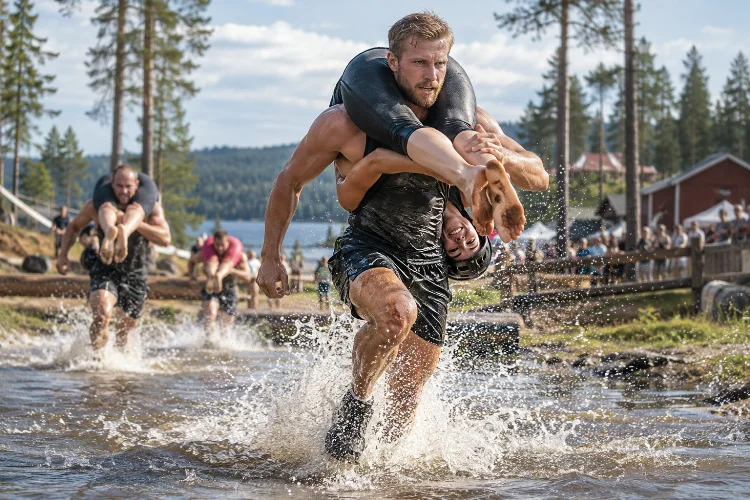
The popular Estonian carrying technique demonstrates this clearly. In this position, the carried partner hangs upside down behind the carrier, with their legs wrapped around the carrier’s shoulders.
Guinness World Records notes that competitors may also use approaches such as piggyback or fireman’s-style carries.
The Estonian method can help distribute the load while keeping the carrier’s arms relatively free, but it still requires both partners to maintain a consistent position.
Experienced teams often practise together because individual fitness alone cannot create good rhythm. The carried partner must learn when to remain relaxed, when to tighten their grip, and how to avoid unnecessary movement.
A pair that moves smoothly can sometimes outperform physically stronger competitors who lack teamwork.
The Water Obstacle Changes Everything
Running with an adult on your back is difficult enough on dry ground. Entering water introduces an entirely different challenge.
The official course includes a water obstacle approximately one metre deep.
Water immediately reduces running speed and increases resistance. Athletes must drive their knees higher, maintain footing, and prevent their partner from slipping as momentum suddenly changes.
Then comes the exit.
Moving from water back onto the racing surface requires another burst of power. Wet shoes and clothing may also affect traction and comfort for the remainder of the race.
This is where explosive leg strength becomes particularly useful. Competitors need enough force to overcome water resistance while still carrying their partner securely.
It also explains why practising only ordinary running would be poor preparation. Successful athletes need to prepare for changing surfaces, unstable movement, and rapid transitions between obstacles.
Grip, Core Stability, and Muscular Endurance
A race lasting roughly one minute might not sound like an endurance event, but muscular endurance becomes extremely important when the athlete is carrying substantial extra weight.
The carrier must maintain posture and power output from beginning to end.
The legs may begin feeling heavy surprisingly quickly. Meanwhile, the abdominal muscles and lower back work continuously to stabilise the load.
Grip also matters, depending on the carrying style being used.
Even when the athlete uses an Estonian-style position rather than holding their partner directly with their arms, the entire upper body must stay athletc and controlled. The shoulders and torso help absorb movement every time the runner accelerates, lands, turns, or clears an obstacle.
This combination makes wife carrying closer to a hybrid of sprinting, obstacle racing, and loaded conditioning than a normal running event.
Why Teamwork Is an Athletic Skill
One of the most overlooked elements is communication.
The fastest carrier in the world would struggle if their partner constantly moved in unpredictable ways.
Before racing, teams need to determine which carrying position feels most secure. Differences in height, torso length, leg length, body weight, and flexibility can influence which technique works best.
During obstacles, even small signals can help.
A partner may need to tighten their legs before a jump, change their body position entering the water, or prepare for sudden acceleration after an obstacle. Practising these movements builds familiarity until responses become automatic.
This is why wife carrying should be viewed as a two-person performance rather than a race involving one athlete and one passive passenger.
Trust also matters psychologically. The carried person must remain confident while travelling quickly, sometimes upside down, toward barriers and water.
That is not always as easy as it sounds.
How Competitive Athletes Might Train for Wife Carrying
Training for wife carrying requires a mixture of strength and conditioning rather than extreme specialisation.
A sensible program could combine heavy compound movements with loaded carries, short sprints, hill running, agility drills, and obstacle practice. Exercises such as squats, deadlifts, split squats, farmer’s walks, and step-ups can develop useful strength.
Sprint intervals can help athletes maintain speed while fatigued.
However, partner-specific practice would probably provide the biggest advantage. Athletes need time to identify a comfortable carrying technique and learn how their combined centre of mass behaves while turning or crossing obstacles.
Safety should remain a priority.
Training immediately at full speed with another person would create unnecessary risk. Athletes could begin with lighter training loads, develop movement mechanics, and gradually introduce real partner carries.
The importance of experience is illustrated by Finland’s Taisto Miettinen. In 2026, the 61-year-old won his ninth Wife Carrying World Championship alongside Katja Kovanen, after decades of involvement in the sport.
His success shows that technique, experience, pacing, and partnership can remain highly valuable even in such a physically demanding race.
More Than Just Finland’s Strangest Sport
Part of the appeal of wife carrying comes from the contrast between serious athletic effort and a deliberately fun atmosphere.
The sport is linked to the local legend of Herkko “Robber” Ronkainen, although the organisers acknowledge that parts of the popular story are based on folklore and creative storytelling rather than fully verified history.
Modern competition has turned that unusual regional story into an international summer event.
In 2026, approximately 2,500 spectators watched the World Championships in Sonkajärvi, and competitors from Finland, Lithuania, the United States, and other nations participated in different events.
That international growth shows why the sport continues to attract attention. It combines legitimate athletic difficulty with humour, tradition, and the kind of spectacle almost anyone can understand immediately.
Finland’s wife carrying races may be entertaining to watch, but competing successfully requires an impressive mix of strength, sprint speed, balance, muscular endurance, obstacle technique, and teamwork.
The 253.5-metre World Championship course forces athletes to carry at least 49 kilograms while navigating dry obstacles and deep water, leaving very little room for mistakes.
Elite performances of less than one minute show just how seriously competitive teams can take the challenge.
Perhaps the most interesting lesson is that brute strength alone is not enough. The best pairs move efficiently as a single unit, combining physical conditioning with trust and technical practice.
So next time you see footage of Finland’s famous wife carrying competition, look beyond the unusual spectacle. You may be watching one of the strangest – and surprisingly demanding – tests of functional fitness around.