Arm wrestling makes immediate sense: lock hands, plant your elbows, and force your opponent’s arm down. Toe wrestling takes roughly the same idea, moves the contest to the feet, and somehow turns it into a surprisingly technical sport.
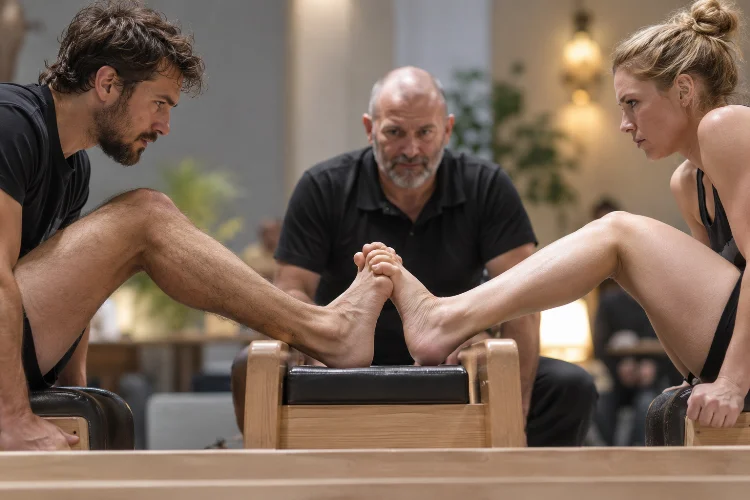
Competitive toe wrestling began in England in the 1970s. Two opponents sit facing each other, remove their footwear, interlock their big toes, and try to force the other competitor’s foot against a target at the side of a special platform.
It sounds simple until rules about body position, foot choice, surrender calls, inspections, referees, and even video review enter the picture.
What makes the sport especially interesting is that these rules did not appear all at once. The earliest version was an informal pub challenge, while modern toe wrestling has developed a much more organised competition format.
Understanding that developement explains how one of Britain’s strangest traditional sports evolved from a joke between friends into a regulated championship with genuine strategy.
Toe Wrestling Started as a Pub Challenge
The modern history of toe wrestling begins in Wetton, Staffordshire, in 1974. According to the sport’s current governing organisation, four regulars at Ye Olde Royal Oak Inn wanted to create a competition in which Britain might become world champion. Their solution was to wrestle using their toes.
The idea was intentionally simple. Competitors locked their toes together and attempted to overpower each other using their legs and feet.
Early versions were even more chaotic than today’s contest. The Toe Wrestling Championship’s historical account says participants originally competed while sitting on stools and tried to knock each other off. That format was eventually abandoned because it was considered too dangerous.
The first recognised World Toe Wrestling Championship followed in 1976 according to Guinness World Records.
That distinction is useful: the sport was invented in 1974, while an organised world championship emerged shortly afterward.
The Toedium Gave the Match Clear Boundaries
One major step toward turning toe wrestling into a proper competiton was creating a defined playing surface.
Modern matches take place on a platform called the Toedium. Two competitors sit opposite each other and interlock their big toes while facing squarely across the competition area.
The objective is straightforward. A wrestler wins a round by forcing the opponent’s competing foot into the upright side post, known as the stanchion. That successful pin is called a Toe Down.
Unlike sports that award points for pressure, position, or near-successes, the current rules are deliberately binary. There are no partial points. Either the opponent’s foot touches the stanchion or it does not.
That rule keeps the strange-looking sport remarkably easy to understand.
A spectator does not need to understand complicated scoring mathematics. Once a foot hits the target, the round is finished.
Why Body Position Is Strictly Controlled
Without positional rules, competitors could use their entire bodies to create leverage rather than relying primarily on their feet and legs.
That is why toe wrestling controls what athletes can do with almost every part of their body.
Under the modern rulebook, competitors remain seated with their backside on the designated line. Their hands must stay flat on the floor, preventing them from grabbing the platform or using their arms for additional leverage.
The foot that is not actively wrestling must also remain raised clear of the platform.
These restrictions have roots in older versions of the rules. A previously published World Toe Wrestling Organisation rule sheet similarly required competitors to keep their palms flat, their non-wrestling foot off the floor, and their bottom on the ground.
The logic is similar to arm wrestling. Control the athlete’s starting position, and the actual contest becomes a more focused test of leverage, leg strenght, toe grip, and technique.
Without those limitations, larger competitors could simply twist their entire bodies or push against the floor to overpower opponents.
The Famous “Toes Away” Call Starts the Action
Even an unusual sport needs a clear starting procedure.
Modern matches begin when the head referee gives the countdown: “Three, two, one, toes away.” Competitors are not supposed to engage before the word “away.”
Older rules also used the phrase “toes away,” showing that this distinctive command has survived as the sport developed.
There is an equally memorable phrase for ending a round voluntarily.
A competitor experiencing too much pressure can surrender by clearly saying “toe much.” Once the surrender is heard, the opponent wins the round and must release the hold.
It sounds like classic British wordplay, but the rule serves a serious purpose.
Toe wrestling places significant rotational pressure on toes, ankles, and legs. Reuters reporting on past championships has described genuine injuries and aggressive tactics among experienced competitors.
Giving wrestlers an immediate verbal surrender mechanism allows them to stop when continuing might become unsafe.
The Match Format Has Changed Over Time
One of the best examples of toe wrestling’s evolution is its round structure.
An older published ruleset described matches as best-of-three contests beginning with the right big toe, followed by the left, then the right again if a deciding round was required.
Today’s official TWC rules are slightly different.
Regular matches remain best of three, but a coin toss now determines which foot is used first. The second round switches to the opposite foot, and if a third round is needed, the coin-toss winner regains the choice of foot.
Finals have become longer still: the current format uses best of five rounds.
That change makes competitive strategy more interesting. Wrestlers may have one foot that is noticeably stronger or more technically efficient, so choosing which side begins can influence the match.
It also demonstrates that toe wrestling rules are not frozen in history. The sport continues adapting as competition becomes more organised.
Foot Inspections Became Essential for Safety
When athletes compete barefoot and directly interlock toes, hygiene cannot be treated as an afterthought.
Modern competitors must therefore pass a pre-match inspection.
The official rules specify that a Toe Inspector checks nails, skin condition, infections, and any athletic tape. Toenails must be cut short and filed smooth, while visible fungal infections can lead to disqualification.
Grip chalk is permitted. Limited tape may also be allowed when it provides legitimate injury support, but it cannot be used simply to improve grip.
Past championship reporting confirms that foot inspections have been part of the sport for years. Reuters described inspection as a standard requirement before competitors entered their bouts.
Recent events have even influenced new rules. During the 2025 World Championship, organisers reported concerns surrounding decorated toenails that caused injuries to opponents, leading to further attention being given to nail regulations.
So while the spectacle remains humorous, the safety rules have become increasingly serious.
Modern Toe Wrestling Uses More Officials Than You Might Expect
The early pub version certainly did not need an elaborate officiating crew.
Modern championship matches can.
The current structure includes a head referee responsible for controlling the contest and two corner referees who watch each competitor’s hands, seating position, and non-wrestling foot.
A Toe Inspector handles the pre-match health check, while a medical officer can remain available for injuries.
Perhaps the most suprising addition is VAR.
According to the official rules, video review may be used during major bouts to examine disputed Toe Downs, foot lifts, or contact with the stanchion.
Video review for two people wrestling with their big toes sounds almost absurdly sophisticated.
Yet it reflects the same problem faced by many mainstream sports: once championship results, rankings, prize money, and reputations matter, close decisions need to be handled consistently.
The humour remains, but the officiating has become considerably more professional.
Champions Helped Turn Strange Rules Into Serious Strategy
Rules alone do not create a competitive sport. Experienced athletes eventually discover how to exploit those rules efficiently.
Few people demonstrate this better than Alan “Nasty” Nash.
Guinness World Records credits Nash with 16 men’s World Toe Wrestling Championship victories between 1994 and 2019, making him one of the defining competitors in the sport’s history.
Successful wrestlers learn to combine toe strength with hip positioning, leg pressure, flexibility, balance, and psychological tactics.
A competitor cannot simply kick sideways as hard as possible. Their hands and seat must remain legal, the unused foot cannot provide extra support, and their active toe must remain securely interlocked.
This creates tactical battles that can last much longer than an outsider might expect. The official account of the 2025 women’s final described approximately 25 minutes of deadlock before the decisive Toe Down.
What appears ridiculous for five seconds can become surprisingly intense when two skilled opponents refuse to give way.
Why the Rules Continue to Evolve
Toe wrestling is currently trying to move beyond its reputation as merely an eccentric British pub sport.
The governing organisation says it has been working toward standardised international rules, athlete pathways, global rankings, consistent officiating, and eventually wider international recognition.
Its long-term ambition even includes another attempt at Olympic recognition after an unsuccessful approach in 1997.
In 2026, the organisation introduced a more formal rulebook covering competition formats, officials, safety procedures, and athlete conduct.
That professionalisation explains why an unusal game invented over drinks now has terminology such as Toedium, stanchion, Toe Zone, Toe Down, Toe Inspector, and even the Toe Rag, which a competitor’s corner can throw in to concede a round.
The rules may be playful in name, but their purpose is familiar: create fairness, protect athletes, and make every match easier to judge.
Competitive toe wrestling developed its unusual rules because a very simple pub challenge gradually needed the same structure found in more conventional sports.
What started with two people locking toes eventually gained a dedicated Toedium, strict body-position requirements, alternating feet, referee commands, surrender procedures, hygiene inspections, medical supervision, and video review.
Even the match format has evolved from the traditional right-left-right sequence to modern coin-toss choices and longer championship finals.
That combination of humour and genuine competition is exactly why toe wrestling has survived for more than five decades.
If you ever watch a World Toe Wrestling Championship, look beyond the bare feet and funny nicknames. Pay attention to leverage, positioning, referee calls, and tactics – you may discover that those strange rules create a much more serious contest than expected.