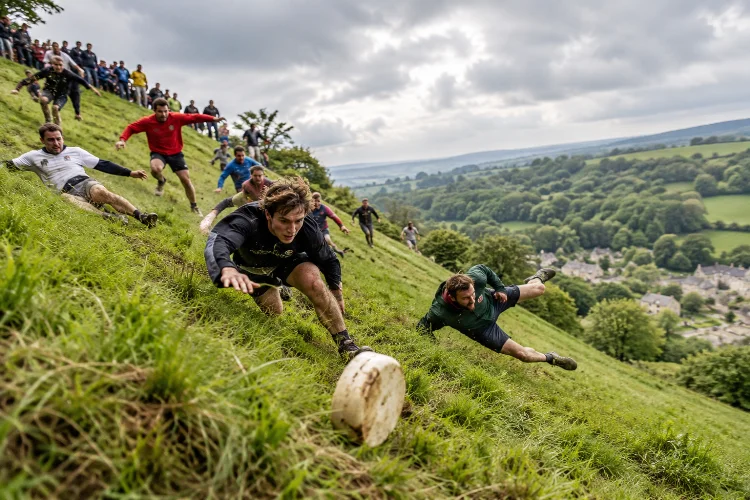
Imagine standing at the top of an extremely steep grassy hill with dozens of people beside you. A large wheel of cheese is released downhill, everyone starts running after it, and within seconds most competitors are tumbling, rolling, or sliding toward the finish line.
It sounds like something invented for a comedy show, but competitive cheese rolling is a genuine British tradition. Every year, Cooper’s Hill near Brockworth in Gloucestershire becomes the setting for one of the strangest sporting events in the world.
The idea is wonderfully simple: chase a wheel of Double Gloucester cheese down the hill and try to reach the bottom before everyone else. In reality, the combination of the steep slope, uneven ground, high speeds, and enthusiastic competitiors makes the race surprisingly intense.
What began as a local custom has gradually become an internationally recognised cultural event. Its exact origins remain uncertain, but its combination of history, community pride, danger, and British eccentricity has helped cheese rolling survive for generations.
The Mysterious Origins of Cheese Rolling
Nobody can say with complete certainty when people first started rolling cheese down Cooper’s Hill.
Historical sources suggest that the custom was already established by the early 19th century.
Some accounts point to references from the 1820s, while Guinness World Records traces a documented cheese-rolling event to 1836. The uncertainty itself has become part of the traditon.
Several theories attempt to explain where the custom came from. One suggests it developed from activities connected with maintaining grazing rights on common land. Another links it to older seasonal or fertility rituals.
According to one theory, people once rolled burning bundles of wood down hills to symbolise seasonal change or encourage a successful harvest.
Over time, those objects may have been replaced by local cheese. However, these explanations remain theories rather than confirmed historical facts.
What seems clear is that cheese rolling became closely connected to the people living around Brockworth and Cooper’s Hill. It was not originally designed as a tourist attraction; it was a community custom that locals simply continued.
How the Cooper’s Hill Cheese Race Works
The basic rules are remarkably straightforward.
Competitors gather near the top of Cooper’s Hill. A wheel of Double Gloucester cheese is released down the slope, and shortly afterward the racers chase it toward the bottom.
The first competitor to cross the finish line wins the race – and traditionally takes home the cheese.
The event website describes the cheese as weighing roughly 7-8 pounds, or around 3-4 kilograms. Several downhill races can take place alongside uphill competitions, including events for different age groups.
Actually catching the cheese is not normally realistic. Once it gains momentum, the wheel can travel extremely quickly.
Visit Gloucester has reported speeds of up to around 70 km/h, while more recent reporting about the cheese-making tradition has mentioned speeds approaching 70 mph under certain conditions.
So the real challenge is not grabbing the cheese. It is reaching the bottom first while somehow keeping yourself moving in roughly the correct direction.
Why Cooper’s Hill Makes the Race So Extreme
Without Cooper’s Hill, cheese rolling would probably be far less entertaining.
The racing area is short but exceptionally steep. The official event information says parts of the hill have an incline of roughly 1 in 2, while the race distance is around 90 metres according to measurements published by the event website.
That steepness changes everything.
Competitors often begin running normally, but gravity quickly takes control. Their legs struggle to keep up with their increasing speed, and many eventually fall forward, tumble several times, get back up, and continue.
Falls are so common that they almost look like part of the sport.
Injuries are also a genuine concern. Smithsonian reported that the 1997 event produced 33 injuries, and previous competitors have suffered broken bones and other serious knocks.
Yet the danger is also part of what gives the competition its unusual reputation. People do not travel across the world to watch athletes carefully jog down a gentle slope. They come to see one of Britain’s most chaotic traditional contests.
Why Double Gloucester Cheese Is Used
The cheese is not a random supermarket wheel.
Double Gloucester is strongly associated with Gloucestershire, making it an appropriate symbol for a local tradition. The round shape also makes it ideal – at least technically – for rolling down a hill.
For decades, the cheeses used at Cooper’s Hill have been connected with the Smart family, traditional Gloucestershire cheesemakers. The event website notes that Diana Smart began supplying handmade Double Gloucester cheeses in 1988.
Today, the family tradition continues, with Rod Smart and his family producing the cheese by hand at their farm in Churcham.
That connection between local food and local culture is important.
Cheese rolling is not simply an unusual race that happens to involve dairy. Double Gloucester links the competition directly to the agricultural heritage and identity of the county.
Even the winner’s prize remains refreshingly simple: rather than a huge cash award or professional trophy, winning a race can mean going home carrying the cheese.
How Cheese Rolling Survived Safety Concerns
The event’s dangerous reputation has repeatedly created difficulties.
In 2010, the organised event was cancelled amid concerns surrounding safety, crowds, and public liability. Normally, that might have ended a small traditional festival.
Cheese rolling responded differently.
Local enthusiasts organised an unofficial version, allowing the custom to continue. The event has since remained strongly community-driven rather than turning into a conventional professional sporting competition.
There have even been attempts to reduce the risks associated with the cheese itself. In 2013, a lighter imitation cheese was used amid safety concerns, but the traditional real Double Gloucester later returned.
This persistence reveals something important about the event. For many supporters, cheese rolling is more than entertainment. Keeping it alive is a way of protecting a piece of local identity.
From Local Custom to Global Spectacle
For most of its history, Cooper’s Hill Cheese Rolling belonged mainly to the surrounding community. Modern media changed that dramatically.
Photos and videos of people violently tumbling down a green English hillside are almost impossible to ignore.
Television coverage, online videos, news reports, and social media introduced the event to audiences who had never heard of Brockworth or Double Gloucester cheese.
International racers soon became increasingly familliar sights.
Competitors and winners have come from countries far beyond Britain, while thousands of spectactors can gather around the hill to watch.
Smithsonian described the event as attracting large crowds, while tourism organisations regularly promote it as one of Gloucestershire’s most unusual attractions.
Its global popularity also works because the race requires almost no explanation. Someone rolls a cheese. Everyone chases it. Chaos follows.
That simplicity translates perfectly across languages and cultures.
Why Cheese Rolling Feels So Uniquely British
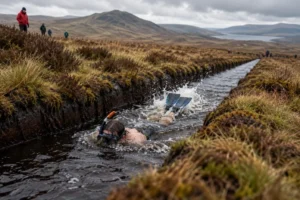
Britain has plenty of unusual traditional events, from bog snorkelling to shin kicking. Cheese rolling fits naturally into that world.
What makes it memorable is the contrast between its absurd appearance and the seriousness with which the tradition is protected.
There are no complicated stadiums or expensive technologies involved. The essential ingredients are a steep hill, a regional cheese, enthusiastic participants, volunteers, local knowledge, and a willingness to accept that getting muddy is almost guaranteed.
The event also represents a type of cultural heritage that does not need to be polished or modernised to remain relevant.
In fact, making cheese rolling too professional might destroy part of its charm. Its unpredictability, community organisation, and slightly chaotic atmosphere are exactly what separate it from commercial sporting events.
That is why Cooper’s Hill remains special: it feels genuinely local even after becoming internationally famous.
Competitive cheese rolling became a unique British tradition because generations of people kept showing up and refusing to let an unusual local custom disappear.
Its origins may never be completely understood, but that uncertainty adds to its appeal.
The historic setting, Double Gloucester cheese, dramatic Cooper’s Hill slope, community involvement, and spectacular tumbles have transformed a Gloucestershire tradition into a global curiosity.
More importantly, cheese rolling shows how cultural traditions survive – not necessarily because they are practical, safe, or logical, but because communities believe they are worth continuing.
If you ever find yourself near Gloucestershire during the Spring Bank Holiday, Cooper’s Hill offers a chance to witness British eccentricity at its finest. Watching from the sidelines, however, may be considerably safer than chasing the cheese yourself.