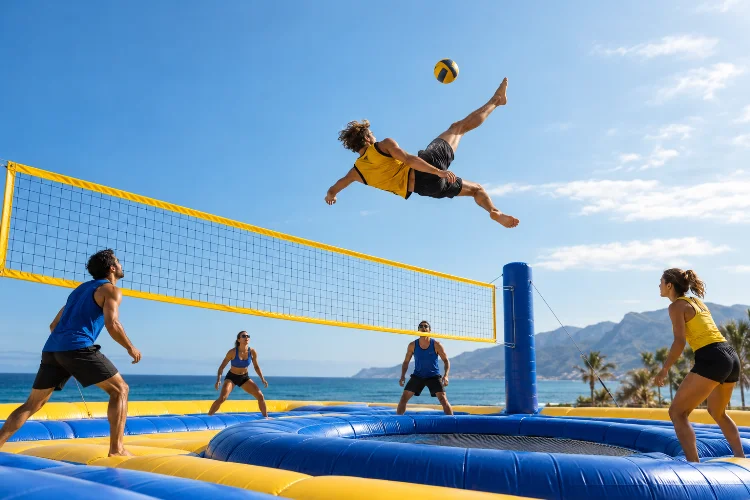
Imagine volleyball played on a giant inflatable court, except one player on each side is bouncing several metres into the air from a trampoline. Instead of limiting themselves to traditional spikes and sets, athletes can use their feet, heads, chests, and other body parts to keep the ball alive.
That is Bossaball.
Developed in the early 2000s by Belgian Filip Eyckmans while living in Spain, Bossaball combines ideas from volleyball, football, gymnastics, and capoeira. The result is a hybrid team sport where timing and ball control matter just as much as jumping ability and creativity.
What makes Bossaball particularly fascinating is how the trampoline changes familiar volleyball movements. Players can launch themselves far above the net, perform bicycle kicks, rotate in mid-air, and attack from angles that would be impossible on a conventional court.
Yet beneath all the spectacle is a surprisingly tactical game. Teams still have to pass accurately, defend space, manage limited touches, and decide when a risky acrobatic attack is actually worth attempting.
How Bossaball Combines Several Sports at Once
Bossaball may resemble volleyball at first glance, but its movement vocabulary comes from several different sports.
The basic objective is familiar: send the ball across a net and make it touch the opponent’s playing area. Teams build attacking sequences by passing between players before setting up someone to finish the rally.
That is where the volleyball influence is strongest.
Football enters the game because athletes are allowed to control and attack the ball using body parts other than their hands and arms. Headers, kicks, chest controls, and spectacular overhead strikes can all become part of a rally.
Gymnastics contributes aerial awareness, body rotation, and landing control. Capoeira influences the sport’s emphasis on fluid, expressive movment and creative kicking techniques.
The official Bossaball description specifically identifies volleyball, football, gymnastics, and capoeira as core influences.
The combination means athletes from different backgrounds can bring very different strengths to the same team.
The Trampoline Completely Changes Volleyball Attack
The trampoline is Bossaball’s most recognizable feature.
Each side of the inflatable court contains a trampoline close to the net. One player can repeatedly bounce there, building enough height to attack the ball from dramatically above normal volleyball range.
This changes the geometry of offense.
In conventional volleyball, players generate jumping height mostly from their own leg power. In Bossaball, the trampoline adds vertical momentum, allowing attackers to wait in the air for a set and strike from a much higher point.
Timing becomes incredibly important.
A teammate must deliver the ball at the right height while the attacker coordinates each bounce. If the set arrives too early, the attacker may still be rising. Too late, and they may already be falling.
Experienced players can turn that timing into spectactular spikes or kicks.
The trampoline also affects defense. Opponents must predict not only where the ball is going, but how a high-flying attacker may change direction in mid-air before making contact.
Players Can Use Volleyball and Soccer Touches
Bossaball’s current rules distinguish between two main ways of contacting the ball.
A volleyball touch uses the hands or forearms. A soccer touch uses other body parts, such as the feet, head, chest, or legs.
Under current official rules, a soccer touch can involve a double contact that still counts as one team touch, while a volleyball touch is a single contact. Teams are allowed a maximum of five touches before returning the ball across the net.
That creates combinations unavailable in normal volleyball.
A defender might control the ball with the chest and foot before another player performs a conventional volleyball set. The trampoline attacker could then finish with either a hand spike or an acrobatic kick.
These options reward players who can switch naturally between football-style ball control and volleyball technique.
They also create more opportunities to rescue difficult rallies.
A ball dropping awkwardly behind a player does not necessarily mean the point is over. A quick heel kick, header, or improvised body control may keep it alive.
Acrobatic Skills Are Useful, Not Just Entertaining
Bossaball produces plenty of highlight-reel moments, but acrobatics are not purely for show.
Body control in the air can provide a genuine competitive advantage.
An attacker who can rotate comfortably may use bicycle kicks or sideways strikes to create unexpected angles. A gymnastically skilled athlete can also adjust their torso while airborne, allowing them to reach balls that would otherwise pass behind or above them.
ESPN reported on Bossaball players with gymnastics and breakdancing backgrounds teaching volleyball-oriented teammates how to perform flips and other aerial techniques. Those athletes, in return, learned volleyball skills from their teammates.
That exchange captures the sport perfectly.
No single athletic background provides everything a player needs.
A volleyball player may understand setting and blocking but lack aerial rotation skills. A gymnast may be comfortable upside down but initially struggle with tactical ball placement.
Bossaball rewards athletes who combine those abilities.
The Scoring System Encourages Creative Attacks
Bossaball does more than allow soccer-style kicks—it actively rewards them.
Under the current official scoring system, a successful volleyball-style attack landing in the opponent’s normal playing area earns one point. If that volleyball attack lands directly in the opponent’s trampoline, it earns three points.
Soccer-style attacks carry even larger rewards.
A soccer touch landing in the normal playing area scores three points, while a direct soccer-style attack into the opponent’s trampoline is worth five points.
That five-point possibility can dramatically change a rally.
Instead of always choosing the safest spike, a skilled player may attempt an overhead kick aimed directly at the trampoline. The execution is much harder, but the reward can shift the momentum of a set immediately.
Bossaball demonstrated this scoring drama during its 2022 exhibitions in Qatar, where organizers highlighted the tactical value of a five-point bicycle-kick attack.
The scoring system therefore encourages flair without making creativity meaningless. Difficult techniques can have greater competitive value.
Teamwork Matters More Than Individual Tricks
A spectacular attacker might receive most of the attention, but Bossaball still depends heavily on team coordination.
The current official format describes teams of four players, with athletes working together to build attacks within the five-touch limit.
Someone has to control the serve.
Another athlete may produce the second touch, while a setter creates an ideal ball for the trampoline player. Defenders also need to cover open inflatable areas when an attacker commits to the trampoline.
Because athletes can play the ball using so many body parts, communication becomes especially important.
In volleyball, teammates can often predict whether someone will use a forearm pass or overhead set. Bossaball provides many more possibilities.
A player might suddenly use a foot instead.
Teams therefore develop patterns so everyone understands who is likely to take the next touch and where the final attack will come from.
Good coordiantion turns acrobatics into strategy rather than random tricks.
The Inflatable Court Encourages More Experimental Movement
Trying bicycle kicks and diving saves on a traditional hard court would create obvious injury concerns.
Bossaball reduces some of that risk through its inflatable playing surface.
The court consists largely of padded inflatable sections surrounding the central trampolines. This gives athletes more freedom to dive, roll, and land after difficult aerial movements.
The area around the trampoline, sometimes called the Bossawall, also influences rallies.
Under the current rules, the ball can bounce or roll on this safety border and remain playable. If it comes to rest there, the point goes to the opposing team.
This creates unusual rebounds.
A ball that appears dead may suddenly bounce from an inflatable section and return toward a defender.
Players need quick reactions because the court itself behaves differently from wood, sand, or grass.
That unpredictability is another reason Bossaball rewards adaptability.
Physical Fitness Goes Beyond Jumping High
Bossaball looks playful, but it demands serious athletic conditioning.
Trampoline attackers repeatedly jump throughout rallies, requiring leg endurance and excellent body control. Meanwhile, players outside the trampoline move across an unstable inflatable surface that can make ordinary changes of direction more tiring.
Core strength becomes especially important.
Athletes need to stabilize themselves while jumping, rotating, kicking, and landing on surfaces that constantly move beneath them.
Flexibility helps with overhead kicks and unusual saves, while shoulder strength supports volleyball-style attacks and blocks.
Cardiovascular endurance also matters because rallies can involve repeated jumps and rapid transitions between offense and defense.
The most effective Bossaball athlete is therefore not simply the person who can perform the biggest backflip.
They need enough athletc control to perform demanding movements accurately while tired.
Music and the Samba Referee Give Bossaball Its Own Identity
Most competitive sports treat music as background entertainment.
Bossaball makes it part of the experience.
The sport’s name references the Portuguese word bossa, associated with style and attitude and strongly linked culturally with bossa nova. Its creators intentionally combined sport, music, creativity, and positive energy.
Even the referee can become part of the performance.
Bossaball events have featured so-called samba referees, who combine officiating responsibilities with an entertainer-like role involving music, percussion, microphones, or DJ equipment.
This does not remove the competitive element.
Instead, it gives Bossaball an identity closer to a sports festival than a silent indoor match.
The music also matches the expressive nature of the sport. Players are encouraged to be creative rather than reducing every rally to the safest possible technique.
That mixture explains why Bossaball has worked particularly well at beaches, festivals, exhibitions, and international promotional events.
International Competition Helped Turn Bossaball Into More Than a Show
Bossaball began as an experimental hybrid sport, but international competition gradually added a more serious sporting layer.
The first Bossaball World Cup was held in Turkey in 2009, with national teams representing Brazil, Belgium, the Netherlands, Kuwait, and Singapore. Brazil won the tournament.
A second World Championship followed in Bonaire in 2013, where the Netherlands defeated Belgium in the final.
Guinness World Records also recognizes the Netherlands for winning two international Bossaball tournaments, in 2013 and 2016.
Those events demonstrated that the sport could function as more than an acrobatic exhibition.
Teams developed tactics, national playing styles, specialist attackers, and competitive approaches to the scoring system.
At the same time, Bossaball has retained its entertainment-driven personality.
That balance between structured competiton and creative freedom remains one of its most distinctive qualities.
Why Bossaball Is More Than Trampoline Volleyball
Calling Bossaball “volleyball on trampolines” is convenient, but incomplete.
Volleyball provides its basic rally structure, yet football touches change how the ball can be controlled.
Gymnastics adds aerial movement, capoeira contributes expressive kicking and body control, and the trampoline creates attacking opportunities unavailable in any of those sports individually.
The scoring system goes even further by rewarding soccer-style attacks with additional points.
That means the sport does not simply borrow movements.
It integrates them into tactical decisions.
A team has to determine whether a risky five-point kick is worth attempting, whether to build a conventional volleyball attack, or whether an extra body-control touch can create a better scoring opportunity.
That is what turns Bossaball from a novelty into a genuine hybrid game.
Bossaball is a fascinating fusion of volleyball and acrobatic skills because every part of its design encourages athletes to think beyond traditional sporting boundaries.
The net and rally structure come from volleyball, while soccer-style touches allow athletes to use almost the entire body.
Gymnastics and capoeira add aerial movement, the trampoline creates extraordinary attacking height, and the scoring system rewards difficult kicks with higher-value points.
Yet successful play still depends on fundamentals: timing, communication, accurate passing, fitness, positioning, and smart decision-making.
If you enjoy unusual sports, Bossaball is worth watching beyond the highlight clips. Pay attention to how teams construct each attack before the final backflip or bicycle kick – the real skill lies in turning spectacular acrobatics into an effective team strategy.