Most swimming competitions take place in carefully measured pools with clear water, lane markers, and athletes using highly refined strokes. World Bog Snorkelling takes a very different approach.
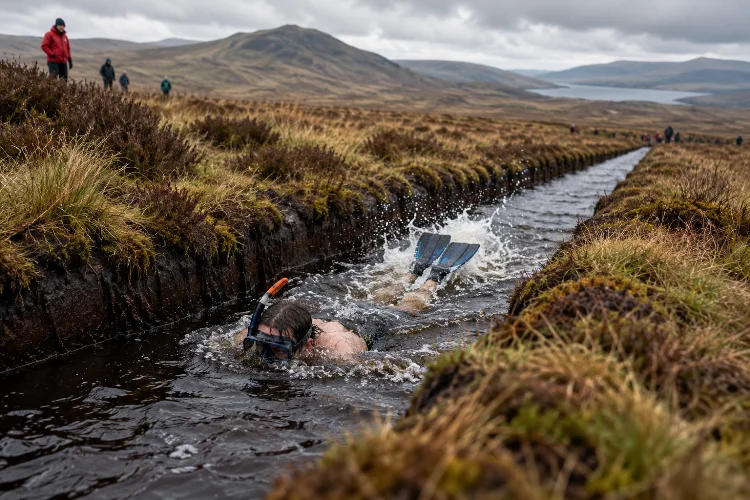
Instead of a pool, competitors enter a dark, narrow trench cut through a Welsh peat bog. They wear masks, snorkels, and flippers, but there is an important catch: conventional swimming strokes are banned.
The World Bog Snorkelling Championships are held at Waen Rhydd bog near Llanwrtyd Wells in Powys, Wales.
The championship began in 1985 and has developed from a wonderfully eccentric local event into an international competition attracting participants from around the world. Guinness World Records recognises it as the longest-running bog-snorkelling championship.
Behind the costumes and muddy water is a surprisingly organised competitive structure. Distance, equipment, categories, timing rules, tie-break procedures, and permitted techniques are all clearly defined.
Understanding those rules reveals why bog snorkelling is far more competitive than it first appears.
How the World Bog Snorkelling Competition Works
At its core, the competiton is a time trial.
Each participant must complete two lengths of a bog trench, covering a total distance of 120 yards, or roughly 110 metres. Competitors travel to the far end, touch the turning post above the water level, turn around, and return to the starting end.
There are two competition trenches at Waen Rhydd. Athletes are allocated a particular trench during registration, and according to the official rules, those allocations cannot simply be exchanged between racers.
Unlike a conventional swimming meet, competitors are primarily racing against the clock rather than directly racing side by side.
The format keeps the championship relatively simple. Every successful competitor produces a finishing time, which can then be compared with other swimmers in the relevant categories.
That simplicity is important because participant numbers can be substantial. More than 150 people from numerous countries competed in the 2023 championship, demonstrating how a small Welsh event has grown into an international attraction.
Why Normal Swimming Strokes Are Banned
The rule that really defines bog snorkelling is what competitors are not allowed to do.
Recognised swimming strokes such as freestyle, breaststroke, backstroke, and butterfly are prohibited.
The official rules permit a doggy-paddle movement, but the hands and arms must remain below the waterline. Many serious competitors instead rely heavily on leg propulson from their flippers.
This dramatically changes race technique.
A strong pool swimmer cannot simply enter the bog and use an efficient front crawl. Competitors have to generate speed primarily through powerful kicking while maintaining a streamlined position inside a narrow, murky channel.
Their faces are also expected to remain in the water while they breathe through the snorkel. Occasional looks forward are permitted so racers can correct their direction.
Because visibility in peat water is limited, direction control becomes an important part of performance. A competitor who repeatedly drifts into the sides of the trench can lose valuable seconds even if they have excellent fitness.
Timing Makes Every Second Count
Timing runs continuously from the beginning of the race until the competitor completes the course. There are no rest periods built into the result.
That makes the turn especially important.
A swimmer who reaches the end quickly but struggles to locate and touch the turning post may lose the advantage they created during the first length. Accelerating again after the turn also requires strong leg endurance.
There is even a procedure for extremely close results.
Under the current official rules, the fastest competitors are considered tied when their times are within 0.2 seconds. If time allows, organisers may stage what they rather appropriately call a “bog-off.”
The tied racers complete another timed attempt to determine the winner.
This small detail shows how seriously the timing side of the championship is treated. The event may look chaotic, but winners can be seperated by fractions of a second.
Competition Categories Give More Racers Something to Chase
World Bog Snorkelling is not organised around a single winner alone.
The official competitive structure includes first, second, and third places for the main male and female championships. There are also separate first-place awards for male and female competitors aged over 50.
Junior categories exist for both boys and girls, while local competitors have separate male, female, and junior classifications.
Junior competitors aged 14-15 must have parental consent and a parent or guardian present.
The structure allows competitive athletes, younger participants, older racers, and local swimmers to compare themselves within more relevant groups rather than treating every entrant identically.
There is also another category that captures the less serious side of the event: fancy dress.
First, second, and third prizes are awarded for costumes, and fancy dress is actively encouraged by organisers.
That unusual mixture is central to the championship’s personality. One participant may be attempting a world record while another enters primarily because snorkelling through a peat bog dressed as a superhero sounded entertaining.
Equipment Rules Keep the Competition Fair
Bog snorkelling does not require a huge collection of specialist gear, but the equipement regulations matter.
Competitors need a snorkel and mask, while flippers provide the main source of propulsion. Organisers advise racers to bring their own snorkel and mask, although a limited number of flippers may be available to borrow.
Not every swimming aid is permitted.
Standard fins can be used, but mono-fins are prohibited. Webbed gloves and similar equipment are also banned.
These restrictions prevent competitors from gaining large mechanical advantages through specialised equipment.
Clothing is far more relaxed. Some participants wear wetsuits, others choose ordinary swimwear, and many arrive in elaborate costumes.
The official information pack essentially allows competitors considerable freedom over clothing as long as the basic snorkelling requirements are satisfied.
A wetsuit can be practical because Welsh bog water is not exactly known for tropical temperatures.
What Separates Fast Bog Snorkellers From Everyone Else?
Competitive bog snorkelling rewards a slightly unusual combination of abilities.
Powerful leg kicking is the obvious requirement. Since conventional arm strokes are unavailable, competitors must create consistent propulsion through their fins.
Body position matters too.
Lifting the head too frequently creates additional drag, while drifting sideways wastes distance. Strong competitors therefore have to remain relatively straight while trusting the snorkel and making only occasional checks of their direction.
Then there is the turn.
Touching the post, changing direction, and accelerating again can easily cost several seconds. Practising an efficient turn could therefore make a significant difference for anyone chasing a competitive result.
Bog snorkelling is also a short, intense endurance event. A racer must maintain aggressive kicking for around one to two minutes rather than settling into the rhythm of a long-distance swim.
World Records Show How Competitive the Sport Has Become
The fastest athletes move through the bog remarkably quickly.
Guinness World Records lists Neil Rutter’s men’s record at 1 minute 12.35 seconds, achieved in Llanwrtyd Wells on August 27, 2023. The championship organiser records the same performance as 1:12.34, a tiny difference likely related to timing or rounding.
Rutter had previously set a record of roughly 1:18.8 in 2018, meaning his 2023 performance cut more than six seconds from his earlier mark.
The recognised women’s benchmark is equally impressive. Kirsty Johnson recorded 1 minute 22.56 seconds in 2014, a performance that once stood as the fastest overall championship time.
Rutter’s competitive record extends beyond one fast swim. Guinness lists him with six World Bog Snorkelling Championship victories between 2017 and 2025.
Those performances demonstrate that while almost anyone can enjoy the event, competing at the top requires real technique, conditioning, and experience.
How an Eccentric Event Became a Real World Championship
Bog snorkelling’s biggest strength may be the way it combines genuine competition with deliberate silliness.
The first World Championship was held at Waen Rhydd in 1985. Apart from interruptions during 2020 and 2021 because of the COVID-19 pandemic, the event has remained a regular part of the Welsh sporting calendar.
Competitors have travelled from Europe, North America, Australia, Africa, and elsewhere to participate. In 2023 alone, organisers recorded racers representing countries including Sweden, Serbia, Denmark, Belgium, Australia, South Africa, Germany, Italy, and the United States.
The competitive framework helps give that eccentricity structure.
There are clear rules, official classifications, world records, equipment restrictions, timekeepers, tie-break procedures, and championship titles.
But nobody has removed the costumes, humour, or mud.
That balance is exactly what makes the event work.
World Bog Snorkelling may look like organised chaos, but its competitive structure is surprisingly precise. Racers must complete 120 yards of peat-filled water, touch designated posts, follow strict propulsion rules, use approved equipment, and finish as quickly as possible.
Separate championship, age, junior, local, and fancy-dress categories make the event accessible to everyone from serious record hunters to participants simply looking for an unforgettable experience.
World-record performances also prove that elite bog snorkelling involves far more skill than simply jumping into muddy water with flippers.
If unusual sports fascinate you, the World Bog Snorkelling Championships are worth watching closely. Behind the mud and ridiculous costumes is a genuine race where technique, endurance, navigation, and fractions of a second can determine who becomes world champion.