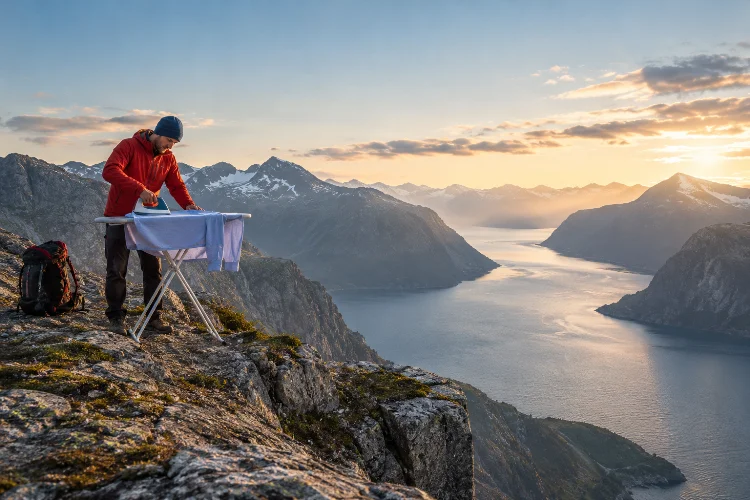
Imagine reaching the top of a mountain after hours of climbing, taking in the incredible view, and then pulling an ironing board from your backpack. Instead of celebrating with a photograph, you carefully press a shirt.
That strange combination captures the spirit of extreme ironing.
The activity mixes one of the most ordinary household chores with environments usually associated with adventure sports. Participants have ironed clothes on cliffs, in rivers, on mountains, underwater, and in other deliberately inconvenient locations.
What started as an eccentric British idea eventually became international enough to produce an Extreme Ironing World Championship.
The cultural origins of extreme ironing competitions are particularly interesting because the activity sits somewhere between sport, performance art, parody, and genuine outdoor challenge.
Its rise reflects Britain’s long affection for unusual competitions, while its absurd contrast between domestic routine and physical adventure made it perfect for television and later internet culture.
To understand why people began carrying ironing boards into extreme environments, we need to return to England in the late twentieth century.
Where Did Extreme Ironing Actually Begin?
The modern extreme ironing movement is most closely associated with Phil Shaw, a Leicester resident who worked in a knitwear factory.
Shaw’s own account places the beginning in 1997. After returning home from work, he faced a pile of ironing but would rather have spent the evening pursuing outdoor activities such as rock climbing. Instead of choosing between the two, he combined them.
He took the ironing outside and gradually developed the idea of pressing clothes in increasingly unusual locations.
There are also accounts of an earlier independent version of the activity associated with Tony Hiam in northern England around 1980. Those stories describe ironing in deliberately inappropriate public locations as a humorous reaction to unnecessary ironing.
However, Phil Shaw is the figure most strongly associated with transforming the idea into the organised, internationally promoted activity known today as extreme ironing.
His 2003 book describes Leicester in 1997 as the starting point for the modern sport and documents its first years of developement.
Turning a Boring Household Chore Into Adventure
The basic joke behind extreme ironing is remarkably simple.
Ironing represents routine, repetition, and domestic responsibility. Extreme sports represent risk, freedom, excitement, and unpredictable environments. Put them together and each side makes the other look more ridiculous.
That contrast became the cultural foundation of the activity.
Shaw reportedly came up with the idea partly because he found conventional ironing boring. Instead of treating the household task as something that prevented him from having an adventure, he turned the task itself into one.
This explains why simply ironing quickly was never the main objective.
The surroundings mattered just as much as the finished clothing. An iron and board placed in a normal living room are unremarkable. Put the same equipment halfway up a rock face and suddenly people want to know what is happening.
Extreme ironing therefore developed as both a physical activity and a visual joke.
Why the Idea Feels Distinctly British
Britain has a long tradition of competitions that combine serious effort with deliberate absurdity.
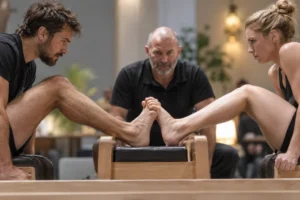
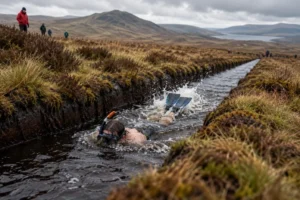
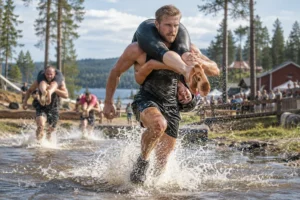
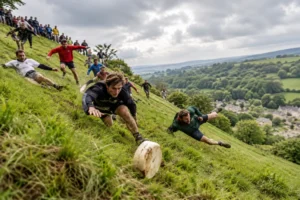
Events such as cheese rolling, bog snorkelling, wife carrying contests, and toe wrestling often take something inherently ridiculous and organise it with enough seriousness to make competition possible.
Extreme ironing fits comfortably into that tradition.
The humour works partly because participants rarely treat the activity as though it is merely a joke. Carrying an ironing board up a mountain, navigating a river, climbing a rock wall, or diving underwater can involve genuine logistical and physical difficulty.
The more seriously participants approach the ridiculous objective, the funnier the contrast becomes.
Contemporary German reporting before the first world championship even compared the activity’s character to distinctly British comedy traditions such as Monty Python and Mr. Bean.
The same report described its appeal as turning extremely boring housework into an adrenaline-producing challenge.
That mixture of understatement, eccentricity, and commitment helped extreme ironing develop a cultural identity well beyond ordinary novelty entertainment.
How Phil Shaw Took Extreme Ironing Around the World
Extreme ironing might have remained a local Leicester story if Shaw had kept his ironing board in England.
Instead, he actively promoted the idea internationally.
In 1999, using the nickname “Steam,” Shaw travelled through locations including the United States, Fiji, New Zealand, Australia, and South Africa. The objective was essentially to spread the concept by demonstrating extreme ironing in different environments.
One particularly important encounter occurred in New Zealand, where Shaw met German travellers interested in the idea.
That connection contributed to the development of an organised German extreme ironing community, commonly known as the German Extreme Ironing Section.
The international expansion changed the activity significantly.
Instead of one British enthusiast creating strange photographs, groups in different countries could now compare techniques, invent new challenges, and compete for recognition.
Extreme ironing had begun moving from personal performance into something resembling an organised alternative sport.
The 2002 World Championship Changed Everything
The biggest step toward formal competition came in September 2002.
The first Extreme Ironing World Championship was held near Munich in Bavaria, Germany. Guinness World Records identifies the event as the inaugural world championship, organised by the German Extreme Ironing Section.
Competitors faced five disciplines: Forest, Water, Rocky, Urban, and Freestyle.
The concept was not simply to press a shirt perfectly. Competitors were assessed on factors including their ironing performance, style, textile results, and speed. Germany’s Inga Kosak won the individual championship with a score of 522.
Reports from the period described competitors ironing in trees, fast-flowing water, climbing environments, and urban settings.
Around a dozen international teams participated, showing how quickly the idea had travelled beyond Britain.
This competition gave extreme ironing something every emerging sport needs: shared standards.
Participants could now do more than produce amusing photographs. They could compare performances under organised conditions.
Why Creativity Became as Important as Athletic Ability
Most conventional sports reward measurable performance.
Run faster, jump higher, lift more weight, or score more goals.
Extreme ironing is different because creativity is fundamental to the activity. A competitor could technically iron perfectly while standing on ordinary ground, but that would miss the entire point.
The challenge must somehow make ironing more difficult, surprising, or visually absurd.
At the 2002 championship, particpants were judged across environments including forests, rivers, climbing structures, and urban obstacles. Freestyle competition gave them even more freedom to develop unusual performances.
This creates an unusual competitive structure in which presentation and imagination matter alongside physical capability.
An experienced climber might iron on a vertical wall. A diver might take an ironing board underwater. Other athletes might combine ironing with kayaking, skiing, cycling, or other adventure activities.
The result is closer to a hybrid of sport and performance art than a traditional race.
Media Helped Turn the Joke Into a Global Phenomenon
Extreme ironing arrived at exactly the right cultural moment.
During the late 1990s and early 2000s, television audiences were increasingly interested in unusual sports, extreme challenges, and reality-style entertainment.
An activity involving ironing boards on mountains naturally produced memorable images.
The first World Championship generated international press coverage, while documentaries and photographs further expanded awareness.
Reports frequently focused on the obvious contradiction: highly motivated athletes putting significant effort into completing an intentionally pointless household task in an unnecessarily difficult location.
That media-friendly quality helped the activity travel.
Extreme ironing did not require complicated explanations. A single photograph of someone ironing while hanging from a cliff communicated the concept instantly.
Later, online video and social media made unusual attempts even easier to share. Athletes no longer needed an official championship to participate; they could invent their own extreme ironing challenge and show it to a global audience.
Underwater Ironing Shows How Far the Culture Spread
One of the clearest examples of extreme ironing’s evolution is underwater ironing.
The idea takes the original absurdity to another level because ironing underwater obviously provides no practical advantage whatsoever.
Yet enthusiasts began turning it into a genuine record challenge.
Guinness World Records states that 173 people took part in an underwater extreme ironing event organised by the de Waterman Diving Club in Oss, Netherlands, on March 28, 2011. They continued ironing underwater for ten minutes.
That record demonstrates how far the concept had travelled from Shaw’s garden.
It was no longer simply a Leicester joke or even a British eccentric sport. Divers in another country were coordinating large-scale events around the same deliberately contradictory idea.
The athmosphere may have remained humorous, but organisation, equipment, diving skills, and safety planning were very real.
Is Extreme Ironing Really a Sport?
Whether extreme ironing qualifies as a “real” sport depends heavily on how sport is defined.
Some versions unquestionably require athletic ability. Rock climbing, diving, skiing, kayaking, and mountaineering all demand physical skill regardless of whether the participant happens to be carrying an ironing board.
But competition has never been entirely about athletic performance.
Creativity, humour, location, difficulty, and quality of ironing are equally important to the identity of the activity.
That ambiguity may actually explain its lasting cultural appeal.
Extreme ironing does not need to choose between being a sport and being a parody of sport. It can be both at once.
The book written by Phil Shaw even classified the activity across both humour and sports-related subject areas, reflecting exactly that strange position.
Its participants can genuinely challenge themselves while simultaneously making fun of the seriousness surrounding extreme sports.
The Cultural Legacy of Extreme Ironing
Extreme ironing’s greatest achievement may not be creating a permanent professional sporting league.
Instead, it showed how easily ordinary routines can be transformed through imagination.
The original concept took something almost aggressively mundane – pressing wrinkles from clothing – and moved it into places where ironing clearly did not belong.
That contradiction produced humour, but it also encouraged adventure.
People climbed mountains, entered rivers, travelled internationally, experimented with diving, and organised competitions because someone decided that household chores did not necessarily have to remain inside the house.
The 2002 World Championship remains an important milestone because it transformed that attitude into an organised contest recognised by Guinness World Records.
More than two decades later, images of extreme ironing still work for the same reason they did originally: they make people stop and look twice.
The cultural origins of extreme ironing competitions reveal much more than the history of an unusual sport.
The modern movement grew from Phil Shaw’s 1997 experiment in Leicester, combining his dislike of ordinary ironing with an enthusiasm for outdoor adventure.
International promotion transformed that personal joke into a global activity, eventually leading to the first World Championship in Bavaria in 2002. From forests and climbing walls to rivers and underwater record attempts, competitors kept expanding what “extreme” could mean.
Its lasting appeal comes from the balance between genuine challenge and deliberate absurdity.
If you enjoy unconventional sports, explore footage and photographs from classic extreme ironing events. You may never look at an ironing board – or an empty mountain summit – in quite the same way again.