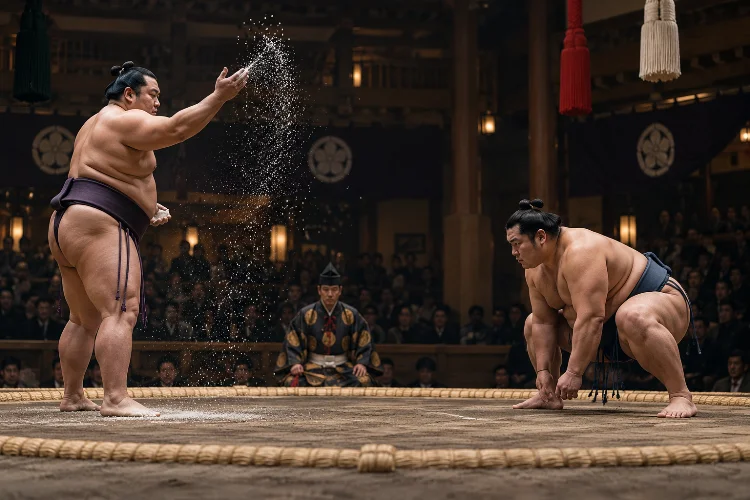
Two enormous wrestlers step into a clay ring, throw salt into the air, stamp their feet, crouch face-to-face, and suddenly explode into action. A bout may end only a few seconds later, yet almost everything surrounding those seconds carries centuries of history.
Traditional Japanese sumo wrestling is far more than a contest of size and strength. Its development reflects changes in Japanese religion, politics, warfare, entertainment, and popular culture.
Early forms were connected with mythology and agricultural rituals. Later, sumo appeared at the imperial court, became useful training for warriors, and eventually developed into a professional spectacle during the Edo period.
Many features spectators recognize today – from the dohyō ring and ceremonial entrances to rankings and professional stables – were gradually created rather than appearing together in ancient times.
That long evolution is exactly what makes sumo fascinating. Modern tournaments may be professionally organized sporting events, but they still preserve customs that connect today’s wrestlers with a remarkably old cultural tradition.
Sumo’s Origins Mix Myth, Ritual, and Early Wrestling
Tracing sumo to one exact starting date is impossible.
Japan’s oldest chronicles, the Kojiki, completed in 712, and Nihon Shoki, completed in 720, contain stories involving contests of strength. One famous account tells of Nomi no Sukune defeating Taima no Kehaya in a violent wrestling match performed before an emperor.
These stories mix mythology and historical tradition, so they should not be treated like modern sports records.
More concrete evidence shows that wrestling-like activities existed in Japan in ancient times. Figurines depicting wrestlers have been found from the Kofun period, while early matches were also connected with prayers for successful harvests.
This agricultural connection is important.
Sumo was not originally separated neatly into “sport” and “religion.” Matches could be ceremonial performances offered to deities, with the result symbolically connected to agricultural prosperity.
Elements of that sacred background remain visible today.
The famous shiko movement, in which wrestlers raise a leg and stamp heavily on the ground, has been associated with older purification traditions intended to drive harmful spirits from sacred space.
Imperial Court Sumo Made Competition More Organized
During the Nara and Heian periods, wrestling moved into an important new environment: the imperial court.
Talented wrestlers were summoned from different provinces to participate in ceremonial competitions before the emperor. These events became known as sumai no sechie and developed into elaborate annual court occasions.
That transition helped make sumo more structured.
Earlier wrestling could be extremely rough. The Japan Sumo Association describes ancient forms as combining elements of wrestling and striking with few restrictions. Under continued court patronage, rules and techniques gradually became more refined.
The court setting also increased the prestige attached to athletic performance.
A strong wrestler was no longer merely proving himself against someone from a nearby community. Exceptional competitors could perform in front of Japan’s political and ceremonial elite.
From Ritual to Recognizable Competition
Court sumo still differed enormously from a modern Grand Sumo tournament.
Even so, recurring events, selected competitors, officials, ceremony, and developing rules all moved the activity toward something recognizable as organized athletic competiton.
This period demonstrates an important feature of sumo’s evolution: ritual and sport did not replace one another. They developed together.
Samurai Turned Sumo Into Practical Combat Training
Japan’s political structure changed significantly with the rise of the warrior class.
From the Kamakura period onward, physical strength, balance, grappling, and the ability to overpower an opponent had obvious military value. Samurai therefore practiced sumo partly as combat training.
This changed the sport’s emphasis again.
Ceremonial performance remained important, but wrestling could also become practical preparation for warriors who needed to control opponents at close range.
During the Sengoku, or Warring States, period, powerful military leaders sometimes supported contests.
Oda Nobunaga was particularly famous for his interest in sumo and organized large matches involving strong wrestlers from different areas. Successful competitors could even receive patronage or positions as retainers.
The samurai era helped reinforce qualities still central to sumo: low-body stability, explosiveness, balance, tactical grappling, and the ability to generate enormous force over a very short distance.
It was not yet the polished professional sport seen today, but its technical identity was becoming clearer.
Edo Japan Created the Foundation of Professional Sumo
The Edo period, beginning in 1603, was one of the most important stages in sumo history.
Japan entered a relatively long period of political stability. As cities expanded and urban entertainment culture flourished, sumo began shifting from warrior training toward public spectacle.
Professional wrestlers appeared, and organized competitions known as kanjin-zumō became increasingly common.
These tournaments were often connected with Buddhist temples and Shinto shrines and could raise money for construction or repairs. Crowds came to watch popular wrestlers compete, turning sumo into mass entertainment alongside cultural attractions such as kabuki.
Many familiar features of modern sumo took shape during this period.
The circular dohyō became established, wrestlers were increasingly organized under professional structures, ring-entering ceremonies developed, and recognizable rankings and traditions became more important. The roots of the modern stable system also emerged during the eighteenth century.
Star wrestlers such as Tanikaze, Onogawa, and Raiden became celebrities.
Sumo was no longer simply something people performed. It was something spectators followed, discussed, and paid to see.
The Dohyō Changed How Wrestlers Actually Fought
One interesting part of sumo’s evolution is that changing the competition space also changed technique.
Modern sumo has a simple basic objective: force an opponent outside the ring or make any part of their body other than the soles of their feet touch the ground.
Earlier wrestling did not always work that way.
Research into Edo-period techniques suggests that before the modern dohyō became firmly established, some wrestling methods emphasized throws and grappling movements that differed from today’s common push-out techniques.
A defined circular boundary transformed strategy.
Suddenly, wrestlers did not always need to throw someone completely to the ground. Driving an opponent backward across the boundary could be enough.
That encouraged techniques such as pushing, thrusting, belt control, and strategic movement around the edge.
Modern professional sumo now recognizes dozens of official kimarite, or winning techniques. The Japan Sumo Association currently recognizes 82, although the traditional phrase “48 techniques of sumo” remains culturally familiar.
So despite sumo’s reputation for pure strenght, technique has always mattered enormously.
Rituals Survived Even as Sumo Became Professional
Few professional sports preserve ceremonial behavior as visibly as sumo.
Before wrestlers actually collide, spectators may see salt purification, clapping, foot stamping, crouching, repeated faceoffs, and careful adjustment of the mawashi belt.
These actions are not simply theatrical decoration.
Many grew from religious and historical traditions connected with purification, respect for the sacred ring, and preparation for competition.
Before major events, a dohyō matsuri ceremony can include offerings such as rice, sake, kelp, and other foods placed within the ring. The ritual asks for safety and good fortune.
The ceremonial ring entrance, or dohyō-iri, also became an important spectacle during the development of profesional sumo. Reliable descriptions date from the eighteenth century, although elements of the ceremony probably developed gradually.
This preservation of ritual is one reason watching sumo feels different from watching many other combat sports.
A bout may be extremely physical, but it takes place inside a carefully maintained cultural framework.
Modernization Changed Rules, Timing, and Championships
Sumo’s appearance can make it seem unchanged for centuries, but the modern sport underwent significant reforms.
The Meiji period beginning in 1868 brought rapid modernization to Japan. Sumo had to adapt to a society increasingly influenced by Western institutions, mass newspapers, modern transportation, and new forms of entertainment.
Even the idea of declaring one wrestler the official tournament champion based on the best overall record is relatively modern. Nippon.com notes that an institutionalized championship system only emerged around the end of the Meiji era.
The starting procedure changed too.
Historically, wrestlers could spend remarkably long periods preparing for the initial charge, or tachiai. Formal time limits and starting lines were introduced during the twentieth century, reducing delays and making tournaments easier to schedule.
The Japan Sumo Association’s chronology records several major reforms: starting lines and preparation-time rules were introduced in 1928, the dohyō was enlarged in 1931, and the four pillars surrounding the ring were removed in 1952 and replaced visually by hanging tassels beneath a suspended roof.
Traditional appearance, in other words, has often been preserved through carefully managed modernization.
The Stable and Ranking Systems Define Modern Sumo
Today’s professional wrestlers belong to training organizations known as heya, usually translated as sumo stables.
A stable is far more than a gym.
Wrestlers train, eat, and traditionally spend much of their daily lives within a highly structured hierarchy overseen by former wrestlers known as elders. Younger competitors often handle chores while learning both athletic skills and expected behavior.
Rank determines almost everything in professional sumo.
The hierarchy includes divisions such as jonokuchi, jonidan, sandanme, makushita, jūryō, and the top makuuchi division. At the highest levels are prestigious ranks including komusubi, sekiwake, ōzeki, and ultimately yokozuna.
Promotion and demotion depend heavily on tournament results.
Modern Grand Sumo holds six major tournaments each year, traditionally lasting 15 days. Top-division wrestlers normally compete once per day, making consistency as important as producing one spectacular victory.
This ranking structure transformed individual wrestling matches into an ongoing sporting career.
Every bout can affect a wrestler’s position, salary, status, and future opportunities.
Sumo Became International Without Losing Its Japanese Identity
Modern sumo is deeply Japanese, but its competitive world is increasingly international.
Wrestlers from Mongolia and numerous other countries have reached professional ranks, with several foreign-born athletes rising to the sport’s highest positions.
This internationalization demonstrates sumo’s ability to change without abandoning its core traditions.
A modern wrestler may come from outside Japan, but entering professional sumo means adapting to its language, stable culture, clothing, training system, ceremony, and highly specific standards of conduct.
That balance between preservation and adaptation has defined sumo throughout its history.
The sport survived because it repeatedly changed: first from sacred ritual to court performance, then martial training, public entertainment, professional competition, and eventually a nationally recognized cultural institution.
Yet enough older customs survived each transformation that a modern spectator can still see clear echoes of Japan’s past.
Why Traditional Sumo Still Matters Today
Sumo provides an unusual example of a sport functioning almost like a living museum.
The hairstyles, ceremonial clothing, gyōji referees, ring entrances, sacred symbolism, stable hierarchy, and wrestling techniques connect several different periods of Japanese history.
Some apparently ancient traditions are actually later innovations, while genuine ancient practices have been modified repeatedly.
That makes sumo more interesting, not less authentic.
Tradition does not always mean freezing something permanently in one historical form. Sumo shows how cultural traditions can survive precisely because generations reinterpret them while protecting the elements they consider essential.
Its evolution from harvest ritual to contemporary arena sport represents more than a history of wrestling.
It is also a story about how Japanese society repeatedly found new purposes for an old cultural practice.
The evolution of traditional Japanese sumo wrestling stretches across mythology, religion, imperial ceremony, samurai culture, Edo entertainment, and modern professional sport.
Early wrestling traditions were linked with harvest rituals and contests of strength.
Imperial sponsorship encouraged more organized competition, warriors valued sumo for combat preparation, and the Edo period created the foundations of the professional spectacle recognizable today.
Later reforms standardized tournament timing, rankings, championships, and the physical ring without eliminating older ceremonies.
That combination explains sumo’s remarkable staying power.
It is simultaneously a competitive sport and a cultural performance carrying visible traces of centuries of Japanese history.
If you ever watch a Grand Sumo tournament, pay attention to what happens before and after each short bout – the rituals, rankings, clothing, and gestures reveal just as much about sumo’s evolution as the wrestling itself.