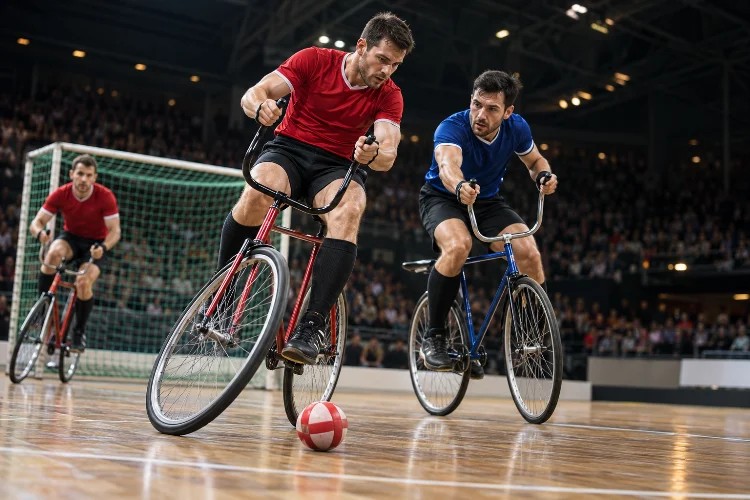
Imagine playing football on a court barely larger than a small indoor gym, except you are not allowed to kick the ball with your feet. Instead, every pass, dribble, defensive block, and shot must be performed while balancing on a specially designed bicycle.
That is competitive cycle ball, also known as radball in German-speaking regions.
The standard two-player version looks simple: score more goals than the opposing team. In reality, it demands extraordinary bicycle control, fast tactical decisions, precise passing, defensive positioning, and constant communication between just two teammates.
Under current UCI rules, elite matches are played on a 14-by-11-metre court with 2-by-2-metre goals. Each team has two players, and matches last two seven-minute halves.
Players normally control and strike the ball using the front or rear wheel of the bicycle, while goalkeepers gain limited use of their hands inside their own penalty area.
With so little space and so few players, every movement can immediately create – or destroy – a scoring opportunity.
Two Players Must Cover an Entire Tactical System
One of the most interesting features of cycle ball is the two-versus-two format.
There is nowhere to hide.
A team generally operates with one player acting primarily as goalkeeper and another as the more attacking outfield rider, although their roles can switch as the match develops.
This creates an unusual tactical balance.
If the outfield player attacks aggressively, the goalkeeper must judge whether to remain deep or move forward to support possession. If both players become too involved in attack, losing the ball can expose an almost empty goal.
Swiss Cycling training materials emphasize that when possession is lost, teams need an immediate division of responsibilities: one player pressures the ball while the other retreats toward the goal.
That decision has to happen almost instantly.
There is no midfield line of teammates ready to rescue a bad choice. One poor positional decison can turn into a shot within seconds.
Bicycle Control Is the Foundation of Every Tactic
Advanced tactics are useless if a player cannot balance the bicycle precisely.
Cycle-ball bikes are designed specifically for the sport. UCI information notes that they use short wheelbases, reinforced frames, and fixed gearing that allows athletes to move forwards and backwards quickly or remain almost stationary while balancing.
That stationary balance is tactically important.
A player may need to wait for an opponent to commit before turning away. Goalkeepers sometimes hold their position almost motionless while preparing to react to a shot.
Putting a foot on the floor creates a serious problem.
Under the rules, a rider who touches the floor becomes temporarily ineligible and must return behind their own goal line before participating again.
This effectively leaves the teammate alone for a short period.
As a result, maintaining balance during physical pressure or tight turns is not simply an impressive technical skill – it protects the team’s tactical structure.
Ball Control Is More Like Dribbling Than Simply Hitting
Beginners might imagine cycle ball as repeatedly smashing the ball with a wheel.
Competitive play is much more controlled.
Swiss Cycling describes skilled players keeping the ball close to the front wheel, using the bicycle itself to shield possession from opponents. Riders combine acceleration, sudden braking, turns, and changes of direction to create space for either a pass or an attacking move.
This resembles football dribbling in principle.
The attacker wants the opponent to commit to one direction, then changes speed or angle before releasing the ball.
But doing this on a bicycle requires exceptional coordination.
The player must simultaneously maintain balance, watch the defender, protect possession, judge the teammate’s position, and prepare the wheel for the next contact.
A heavy touch can give the opponent possession immediately.
That makes controlled first contact especially important, because good possesion creates the foundation for the entire attacking sequence.
Passing Creates Space on a Very Small Court
With only two teammates, passing may appear limited.
In practice, precise combinations are one of the best ways to break defensive pressure.
Swiss Cycling coaching material emphasizes quick, accurate passing and notes that the first pass can shape the entire attacking sequence.
The reason is simple.
Defenders can use their bicycles to block direct paths toward goal. Moving the ball sideways forces them to change position and may open a new shooting lane.
Timing is just as important as accuracy.
A teammate needs the ball arriving at the correct angle relative to the front wheel. A poorly weighted pass can force them to stop or turn awkwardly, allowing the defender to recover.
Teams therefore build attacking patterns much like combinations in football or hockey.
One player draws pressure, releases a pass, then moves into a new position while the teammate either returns the ball or creates a shooting opportunity.
Because the court is small, these actions happen very quickly.
Shooting Is About Angles, Timing, and Deception
Cycle-ball shots can be surprisingly powerful.
The UCI reports that attacking strikes can reach roughly 90 km/h, despite the ball being hit by a bicycle wheel rather than a foot.
Power alone, however, does not guarantee a goal.
Swiss Cycling’s current training framework emphasizes choosing the appropriate shooting technique, timing the strike correctly, and creating chances through precise passes or set plays.
Players can attack using different wheel contacts and approach angles.
A goalkeeper positioned squarely in front of the ball may cover much of the 2-by-2-metre goal. The attacker therefore tries to move the defense before shooting.
A pass across the court can force the goalkeeper to shift laterally. A fake attack may draw the outfield defender toward the ball. Suddenly, a narrow shooting lane appears.
Set pieces matter too.
Corner plays, free hits, and four-metre penalties can produce highly rehearsed scoring opportunities.
A successful team does not simply shoot whenever the ball is close enough. It manipulates defenders until the probability of scoring improves.
Goalkeeping Requires More Than Blocking Shots
Cycle-ball goalkeepers have one unusual privilege: inside their own penalty area, they can use their hands under specific conditions.
That makes goalkeeping fundamentally different from ordinary outfield play.
Current coaching guidance from Swiss Cycling emphasizes active positioning. The goalkeeper adjusts toward the ball to cover as much of the goal as possible and can save shots using the bicycle, body, or hands.
Positioning becomes a geometric problem.
Move too far toward one side and the opposite part of the goal opens. Stay too deep and the attacker gains time to choose a corner.
The goalkeeper also has an offensive responsibility.
Catching or controlling the ball can become the first action of a counterattack. Instead of merely stopping the shot, the keeper should immediately assess whether the opposing team is temporarily out of position.
That means elite goalkeepers constantly switch between defending and initiating attacks.
A good save is valuable.
A good save followed by an immediate counterattack can be even better.
Transitions May Be the Most Important Tactical Moments
Many team sports are decided during transitions—the seconds immediately after possession changes.
Cycle ball exaggerates this effect because only four players are on the entire court.
When a team wins the ball, the opponent may briefly have poor defensive shape. Swiss Cycling specifically trains players to recognize this moment and either attack quickly or, when a counterattack is unavailable, secure possession and build more patiently.
The opposite applies after losing possession.
One player must pressure the new ball carrier while the other protects the goal.
Hesitation is dangerous.
If both riders retreat, the opponent gains time and space. If both attack the ball, a simple pass can leave the goal exposed.
Strong teams therefore develop automatic transition habits.
They do not need lengthy verbal discussions about who attacks and who covers.
Through repeated training, each rider reads the teammate’s position and understands their own responsibility almost immediately.
That level of coordiantion is one of the clearest differences between casual play and elite competition.
Defensive Pressure Is About Controlling Space
Cycle ball allows defenders to influence attackers without simply charging into them.
Swiss Cycling describes effective defense as intelligent positioning, active pressure, blocking routes toward goal, and forcing inaccurate passes or turnovers.
The defender therefore thinks about space rather than only the ball.
If an attacker prefers moving toward the center, the defender may position the bicycle to make that path difficult and encourage movement toward a less dangerous angle.
This resembles defensive positioning in football, basketball, or hockey.
The difference is that the bicycle itself creates a large physical barrier.
A rider can use positioning to protect passing lanes while remaining ready to challenge the ball.
Overcommitting remains risky.
Once the defender moves too far in one direction, changing course takes time – even on a highly maneuverable cycle-ball bike.
Elite defenders pressure aggressively without losing the ability to recover.
That balance requires excellent anticipation.
Penalties Make Discipline Tactically Important
Fouls can be extremely expensive in cycle ball.
Rules violations outside the penalty area may result in free hits, while certain infringements in the defensive penalty area lead to a four-metre penalty.
At that distance, an attacker gets a major scoring opportunity.
The penalty taker shoots directly toward goal while the goalkeeper begins from a regulated position near the goal line.
This makes defensive discipline essential.
A desperate challenge might prevent one immediate scoring chance but concede an even more dangerous penalty.
Players therefore have to judge when to challenge and when to remain between the attacker and the goal.
That is especially difficult because matches are short.
In two seven-minute halves, conceding one unnecessary goal can completely change the tactical situation.
A team that falls behind may be forced to attack more aggressively, creating even more counterattacking opportunities for the opponent.
Fixed-Gear Bikes Enable Unique Tactical Movement
Cycle-ball tactics would look completely different on ordinary road bikes.
The fixed-gear system allows riders to reverse quickly, balance in place, and make extremely tight adjustments without putting a foot down. The unusual handlebar shape and compact geometry further support technical ball control.
Backward movement is particularly useful.
A defender does not always need to turn the entire bicycle and ride away from an attacker. They can retreat while remaining oriented toward the ball.
Similarly, a player waiting for a pass may move only a few centimetres forward or backward to create the correct wheel angle.
These tiny movements matter because cycle ball happens in such limited space.
The best players appear almost attached to their bicycles.
They shift body weight, rotate the handlebars, hop sideways, reverse, accelerate, and stop without disrupting their tactical awareness.
The bicycle is not simply transportation.
It effectively becomes part of the player’s body.
Team Chemistry Can Matter as Much as Individual Skill
A cycle-ball pair needs an unusually close understanding.
With only two players, both athletes are involved in nearly every attack and defensive sequence.
Teammates must anticipate where each other will move, who will press after losing the ball, when the goalkeeper will come forward, and where a pass should arrive.
Communication helps, but many decisions happen too quickly for lengthy instructions.
That makes familiarity extremely valuable.
Partners who have played together for years can recognize body position and bicycle angle almost instinctively.
They know when a teammate is preparing to shoot, when a pass is likely, or when defensive cover is needed.
History provides an extreme example of successful partnership: Czech brothers Jindřich and Jan Pospíšil won 20 UCI World Championship titles between 1965 and 1988.
Individual technical excellence clearly mattered, but sustained success in a two-person sport also highlights the value of partnership.
A Short History of Competitive Cycle Ball
Modern cycle ball traces its beginnings to the late nineteenth century.
The UCI records an early game involving artistic cyclists Nick Kaufmann and John Featherly in Rochester, New York, in 1883. The sport later spread to Europe and became particularly established in Germany and neighboring Central European countries.
The first UCI World Championships were held in 1930.
Today, cycle ball remains part of the UCI Indoor Cycling World Championships and also has an international World Cup circuit.
The sport has traditionally been strongest in countries such as Germany, Austria, Switzerland, and Czechia, while participation has expanded into countries including Japan and other parts of Asia.
Recent competition structures have continued to evolve as well. From 2025, the men’s World Championship structure moved toward Elite and Challenger league groupings, while women’s cycle ball has also gained a growing international championship presence.
Despite these developments, the fundamental tactical challenge remains wonderfully simple:
Two riders, one ball, one small court, and almost no room for mistakes.
The tactical demands of competitive cycle ball come from combining football-style decision-making with extraordinary bicycle control.
Players must maintain balance, protect possession, pass accurately, manipulate shooting angles, defend space, and switch between attack and defense almost instantly.
Goalkeepers need both shot-stopping ability and the awareness to launch counterattacks, while outfield riders must pressure opponents without leaving the goal exposed.
Because each team has only two players, every mistake becomes magnified.
A lost ball, missed defensive assignment, unnecessary foot touch, or poorly timed challenge can immediately create a scoring chance.
If you want to understand cycle ball better, watch a high-level match and ignore the spectacular bicycle skills for a few minutes.
Follow the positioning instead. The constant movement between pressure, cover, possession, and transition reveals just how tactically sophisticated this unusual cycling sport really is.